Home / Solutions / Electrician retail and member operating solutions
BUSINESS SOLUTION

E-commerce Retail

It is not only the completion of the billing but also the linking of goods, stocks, doors, performance, membership and marketing into a sustainable trading system.

More stable transaction processesOnline and offline inventory coordinationMember assets operationalMarketing is more flexible
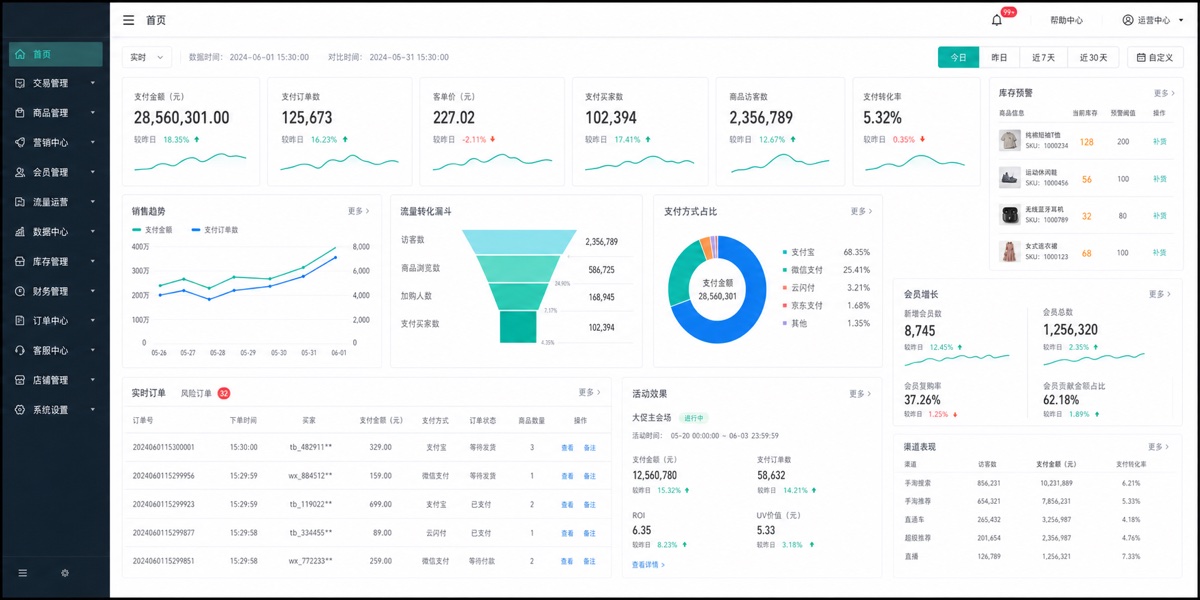
Electrician trade order membership and marketing operating system
Direct findings

Principles for the implementation of the electricity retail system

The electronic retail system should first guarantee the closure of transactions for goods, prices, inventories, orders, payments, refunds and performance, and then expand membership and marketing.

FIT & BOUNDARY

Application of scenes and enforcement of boundaries

The question is first determined whether the issue is suitable for resolution through this programme, and then the scope of the construction and the pace of inputs.

Operational challenges

Channel orders are separated from inventory and performance is prone to error

Marketing rules are complex, and activity depends on R&D.

Membership data are scattered and cannot be sustained.

Large-volatilisation volatility affects transaction stability

Programme capacity module

01

Centre for Commodities and Prices

02

Shopping vans, orders and payments

03

Stock and compliance synergies

04

Membership, points and interests

05

Marketing activities and preferential rules

06

Business analysis and user hierarchy

Proposed programme structure

The architecture level will be tailored to existing systems, data conditions and first-phase targets, with a focus on ensuring that business, data, integration and operational responsibilities are closed.

Channels and stores

(c) Carrying of commodity browsing, trading and membership services for small programs, Web, APP, POS or the conductor.

Trading Core Level

Uniform order status, refunds, pre-inventory, price calculation and performance organization.

Operational capability level

Management of goods, stores, members, interests, activities, preferential rules and content configuration.

Integrated and Reconciliation Layer

Connect ERP, warehousing, logistics, payments, invoices and third-party platforms and address retesting and discrepancies.

Data and Stability Layer

Building business indicators, user hierarchy, surveillance and alarm, capacity management and strategies to promote downscaling.

Boundary of responsibilities and collaboration between the parties

ZhiHua Tech is responsible for trading architecture, product prototypes, system development, interface interface, performance testing and release support

Businesses are responsible for identifying goods, prices, inventories, refunds, membership and marketing rules, and those responsible for operating

Third-party providers such as payments, logistics, ERPs, provide business qualifications, sandboxes, interface files and problem responses

Both parties jointly completed the actual orders, refunds, inventory, reconciliations and the receipt and inspection of the malfunction scene

Programme delivery results

SOLUTION OUTPUTProcesses and product prototypes
SOLUTION OUTPUTBusiness City and the backstage of operations
SOLUTION OUTPUTInterfacing, etc., in payment logistics
SOLUTION OUTPUTActivity and membership configuration
SOLUTION OUTPUTPerformance test and go-live

Verifiable delivery evidence

(b) Retain reversible and accessible engineering materials at each stage, without oral representations in lieu of acceptance.

DELIVERY EVIDENCEDescription of rules for trading machines, inventory and refunds
DELIVERY EVIDENCEPayment, logistics, invoices and ERP interface billing
DELIVERY EVIDENCEReal business scene testing and reconciliation records
DELIVERY EVIDENCEPerformance pressure measurement, capacity assumptions and downgraded scenarios
DELIVERY EVIDENCEOperation configuration, roll-back and training materials

Recommended acceptance and inspection baseline

01

Orders, payments, cancellations, refunds, deliveries and sale chains closed by agreement

02

Orders, payments, inventory and financial critical data can be tracked and reconciled

03

Repeated requests, overtime, failure of recall and unusual availability of compensation mechanisms for third parties

04

Door, headquarters, passenger service and operating privileges are in line with role boundaries

05

Core flow scene meets agreed response time and capacity targets

SCENARIO WALKTHROUGH

The electrical retail system is being rolled out.

A quantifiable capability scenario is used to describe how problems are defined, programmes designed and production acceptances completed.

Site Start

First, we'll deal with the one link that most affects business.

Assuming that an enterprise first encounters “a cut-off of a channel order and inventory, performance is prone to error.” The project team does not directly purchase tools, but selects the real task in the near future, recording monthly processing volumes, average waiting and processing times, a completion rate, manual revision rates, unusual types and responsibility departments. The figures must be from systems records or manual samples that the client can review; short-cycle accounts are created when information is insufficient, rather than for the creation of a fictional ROI.

How the indicative list should be designed

The following figures are used only to demonstrate measurement methods: if the original process handles 1,200 tasks per month, waits an average of 6 hours, actually processes 12 minutes, manual returns a rate of 15 per cent, the first target can be defined as “a 30 per cent reduction in waiting time, a 20 per cent reduction in manual processing time and a return rate not higher than the original baseline.” The receiving and inspection process provides both original samples, statistical queries and an unusual list. If the processing volume, business rules or sample difficulty changes significantly, the processing should be re-corrected and not just a good-performing date should be chosen to reach a conclusion.

The role privileges, historical data, external interfaces, capacity, security, backup and back-up checks should also be completed before official access. The first observation cycle after the line is run by the head of operations: check the real rate of adoption and then analyse the reasons for non-use, manual modification and mission failure. Only if the user continues to use and the quality floor does not decline will improvements in efficiency or performance indicators be of interpretive value.

DELIVERY PATH

From diagnosis to continuous operation

Each stage has clear objectives, participatory roles and assessable outcomes, and important decisions are not left to the end of the project.

01Business model combing
02Trade closed circle design
03Core system construction
04Access to the portal.
05Operational iterative optimization
FAQ

FAQs

The most common issues before cooperation are clearly stated in advance.

What about Applet and the Independent APP?+

Micro-credits and light transactions can give priority to small programs; the evaluation of APPs is conducted when high frequency use, complex capabilities or independent user experience is required.

How can we respond to the need for a confluence of efforts?+

There is a need to combine traffic forecasting with the design and measurement of entry-limit flow, caches, walk-through, inventory consistency and downgrade scenarios.

DECISION FAQ

Common issues related to current projects

Check out all 265 questions.
Software development and outsourcing of projects

How much does custom software development usually cost?

The customized software does not have a uniform price based on page size, and costs are determined mainly by scope, interface, data, authority, performance and accountability for delivery. The management system with the same name may be a single-sector tool or a connection to orders, inventory, finance and multi-organizational authority. It is recommended that the first business closed loop and receiving and inspection boundaries be established, and that the product, design, development, testing, deployment and maintenance workload be estimated. Any precise total price given without knowledge of the need be considered only as a marketing reference.

View full answer
Software project start-up and programme selection

Software requirements are incomplete, so can we first have an external firm to assess them?

It is possible, and if demand is incomplete, to make a limited needs diagnosis first, rather than directly demanding a fixed total price. An enterprise simply needs to state its business background, target users, current problems, time to go online and available budgets.

View full answer
Software project start-up and programme selection

Only ideas don't have a product manager. How do you start the software project?

The absence of a product manager does not mean that it cannot be started, but it must be clear who will make the business priority and acceptance decisions on an ongoing basis. Interviews, needs analysis, prototypes and version planning can be facilitated by external product consultants or delivery teams, and there is still a need to identify a business leader within the enterprise to confirm the rules.

View full answer
Software project start-up and programme selection

Can software projects develop MVPs before progressive improvement?

Yes, but MVPs must be the smallest closed loop that can validate key assumptions, not the full product of poor quality. Target users, behaviours to validate, core processes, data indicators and matters for not developing for the time being should be identified, while keeping the necessary security, backup and error processing. When validation is successful, it can be scaled up by data and then reoriented at lower cost.

View full answer