Home / Solutions / OPC Technical Support and AI Agent Workstation
BUSINESS SOLUTION

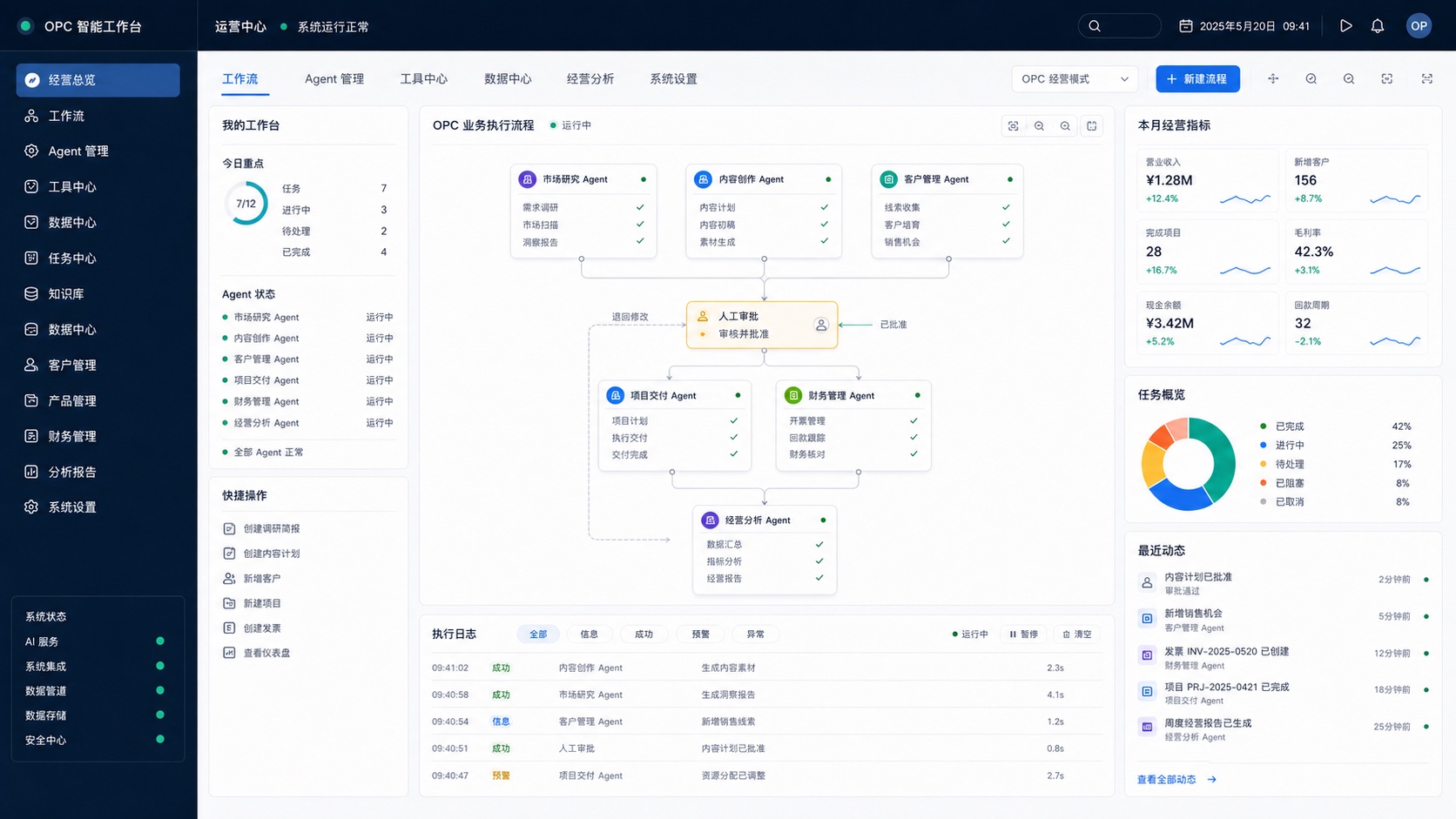
OPC AI Agent Workbench

Using a core operator as the centre of decision-making, multiple professional Agents work together around harmonizing knowledge, tasks and business data, gradually distilling individual experience into a repertoireable business system.

Reduce duplicate switching and manual operationsExpanding the scope of individually manageable operationsRetain manual decision-making on key mattersKeeps experience and process sunk.
One company manages customer content delivery and business data through a professional Agent desk
Direct findings

Principles for the implementation of the OpC AI Agent workstation

The OPC AI Agent workstation should be built around a real closed ring in the recipient, sale, delivery or operation, rather than buying a large number of tools at once.

FIT & BOUNDARY

Application of scenes and enforcement of boundaries

The question is first determined whether the issue is suitable for resolution through this programme, and then the scope of the construction and the pace of inputs.

Operational challenges

One person has the role of both marketing, marketing, delivering and operating

Information spread over chats, documents, tables and multiple online tools

The lack of uniform standards for AI outputs and difficulties in the validation and tracking of critical actions

Increase in duplication of work as a result of business growth, with individual time becoming the main bottleneck

Programme capacity module

01

OPC Operations and Mission cockpit

02

Market research, content, CRM and delivery to Agent

03

Personal knowledge base and business template centre

04

Task organization, timing and manual approval

05

Web sites, mailboxes, documents, forms and business tool integration

06

Implementation logs, quality assessments, privileges and cost monitoring

Proposed programme structure

The architecture level will be tailored to existing systems, data conditions and first-phase targets, with a focus on ensuring that business, data, integration and operational responsibilities are closed.

Level of operational objectives and indicators

Manage clients, products, trails, projects, income and key business indicators, and identify the operational results of Agent services.

Knowledge and business data layer

Render branding, methodological templates, client context and project experience, and configure sources, versions and access rights.

Agent and Work Stream

Configure Agent, rules, approval, retesting and abnormal retreats by research, content, sales, customer service and task delivery.

Tool-integrated layer

Connecting websites, forms, mailboxes, documents, calendars, CRMs, project tools and news channels to reduce manual handling.

Governance and operations level

Recording of implementation logs, quality, manual interventions, model costs and operational results, and continuous phasing out of low-value processes.

Boundary of responsibilities and collaboration between the parties

SVP technicalization, tool selection, Agent and workflow implementation, system connectivity and training

Clients are responsible for determining products, customer commitments, brand calibres, business rules and critical actions approvals

The parties jointly establish a sample of tasks, quality standards, boundaries of authority and a mechanism for the resumption of effects

Programme delivery results

SOLUTION OUTPUTOPC Workstream Blueprint
SOLUTION OUTPUTTool chain and account scheme
SOLUTION OUTPUTAgent and automated processes
SOLUTION OUTPUTTask template
SOLUTION OUTPUTDeployment of training and operating boards

Verifiable delivery evidence

(b) Retain reversible and accessible engineering materials at each stage, without oral representations in lieu of acceptance.

DELIVERY EVIDENCETask flowchart, Agent responsibilities and manual approval matrix
DELIVERY EVIDENCEList of knowledge sources, template versions and data rights
DELIVERY EVIDENCESamples of key tasks, results of implementation and quality assessment records
DELIVERY EVIDENCETool Connection, Failed Retest and Unusual Back Test Record
DELIVERY EVIDENCEModels, tools and automated running cost statistics
DELIVERY EVIDENCEOperations manual, account list and training handover records

Recommended acceptance and inspection baseline

01

Assignment of tasks can be triggered, executed, approved and terminated as agreed

02

The results are produced or judged to meet the quality standards of the concentration of samples

03

High-risk movements must be manually identified.

04

Tool call failed, repeated triggers and timeout can be detected and processed

05

Knowledge, client and project data comply with agreed boundaries

06

Operators are able to independently view operational status and maintain common templates

SCENARIO WALKTHROUGH

Implementation of the OPC AI Agent Workstation

A quantifiable capability scenario is used to describe how problems are defined, programmes designed and production acceptances completed.

Site Start

First, we'll deal with the one link that most affects business.

Assuming that an enterprise first encounters “a person who simultaneously assumes the role of product, marketing, sales, delivery and operation”. The project team does not directly purchase tools, but selects the real task in the near future, recording monthly processing volume, average waiting and processing time, a completion rate, manual revision rate, unusual type and responsibility department. The figures must be from systems records or manual samples that the client can review; short-cycle accounts are created when information is insufficient, not for the purpose of building a fictional ROI.

How the indicative list should be designed

The following figures are used only to demonstrate measurement methods: if the original process handles 1,200 tasks per month, waits an average of 6 hours, actually processes 12 minutes, manual returns a rate of 15 per cent, the first target can be defined as “a 30 per cent reduction in waiting time, a 20 per cent reduction in manual processing time and a return rate not higher than the original baseline.” The receiving and inspection process provides both original samples, statistical queries and an unusual list. If the processing volume, business rules or sample difficulty changes significantly, the processing should be re-corrected and not just a good-performing date should be chosen to reach a conclusion.

The role privileges, historical data, external interfaces, capacity, security, backup and back-up checks should also be completed before official access. The first observation cycle after the line is run by the head of operations: check the real rate of adoption and then analyse the reasons for non-use, manual modification and mission failure. Only if the user continues to use and the quality floor does not decline will improvements in efficiency or performance indicators be of interpretive value.

DELIVERY PATH

From diagnosis to continuous operation

Each stage has clear objectives, participatory roles and assessable outcomes, and important decisions are not left to the end of the project.

01Business closed loop combing
02HF task standardization
03Agent Prototype Validation
04Tools and data set-up
05Operational assessment optimization
FAQ

FAQs

The most common issues before cooperation are clearly stated in advance.

Can you access the tools in use?+

A site, mailbox, enterprise micro-mail, documents, tables, CRM and project tools can be taken first, and API, automated platform or custom integration can be selected according to interface, privileges and cost.

Can Agent send a message or operate a business system directly?+

Tools could be called within the clear delegation of authority, but it was recommended that they be classified on a risk basis: low-risk assignments were automatically performed, high-risk actions were increased by manual recognition, log audits and failure retreats.

DECISION FAQ

Common issues related to current projects

Check out all 265 questions.
One-man company and OPC technical support

What technology tools should be deployed first when a single company is starting to operate?

A company does not need to purchase complete enterprise software from the outset, but first establishes six basic types of customer trails, project assignments, documentation knowledge, contract collection, account security, and data backup. Each type prioritizes a primary tool that runs the shortest process from the time of the receipt to the time of delivery, and adds automation and AIAgent based on duplication of effort. The more efficient the tool, the more important is whether it can produce a unified record and stabilize the process.

View full answer
FDE, OPC and AI Project Delivery

What is the normal content of technical support by an OPC company?

The first phase should be built around a true closed circle in the recipient, sale, delivery or operation, rather than a large build-up of AI tools. The tool is to be consistent with the individual's time, budget and maintenance capabilities. The ultimate goal is to reduce duplication of effort while retaining manual control over client commitment and key decision-making.

View full answer
One-man company and OPC technical support

How can a company provide technical support at a fee, suitable for project or long-term service?

One-time website, system deployment, interface development or automated buildup is suitable for a phased range of offers; ongoing operations, tool maintenance, Agent optimization and failure response are more appropriate for monthly technical support. If the need is not clear, short-term diagnostics can be purchased, priority, boundaries and budgets determined before choosing the modalities of cooperation.

View full answer
One-man company and OPC technical support

Does a company need a CRM, project management and knowledge base?

Whether or not information is complex is not the number of companies. When clients exceed memory control, the project has multiple nodes, and the programme needs to be reused, the corresponding system should be put in place; but the three capabilities need not be provided by three heavy platforms.

View full answer