
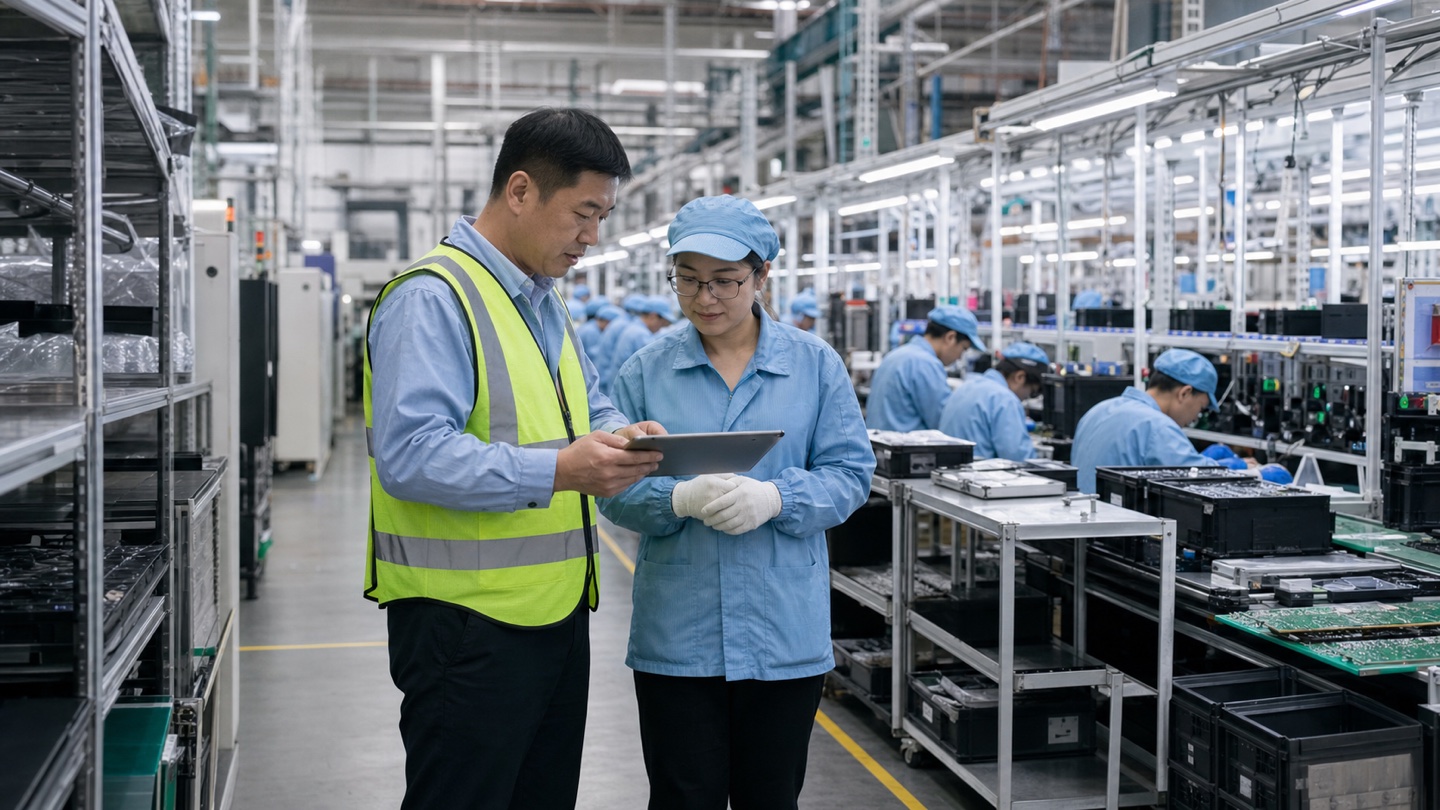
Policy signal: AI is moving from demonstration projects to production system capacity
The Shanghai City Economics and Information Technology Commission (SECI) issued measures in July 2026 to further promote “AI+ manufacturing” with a focus on industrial niche models, industrial intelligence, physical AI, industrial software, and industrial Internet. The National Initiative on “Advanced Intelligence+ Manufacturing” also explicitly promotes the use of the principles of field-drivenness, safety and industrial intelligence in the development, testing, production, quality control, transport, supply chain and management of operations.
This means that the manufacturing firm's AI project cannot be targeted solely at “finishing a question and answer assistant.” A more valuable way to build is to embed AI in the production business closed loop, so that it can read credible data, understand business constraints, make recommendations, trigger controlled actions, and continuously optimize through feedback on results.
- Research and development links: knowledge retrieval, design aids, document and regulatory inspection
- Production chain: Emission support, process analysis, abnormal diagnosis and quality prediction
- Equipment chain: smart inspection, fault identification, predictive maintenance, synergy with worksheets
- Business chain: order analysis, inventory warning, supply chain synergy and business forecasting
Not from the model capacity, from the production bottlenecks.
The high value of manufacturing sites is often hidden in delivery cycles, good rates, downtime, inventory, energy consumption, and manual experience. Enterprises should first identify bottlenecks that affect their business outcomes, and then judge whether AI can improve this bottleneck by identifying, predicting, retrieving, generating or organizing their tasks.
The scenarios suitable for the first pilots usually have four conditions: high frequency of operations, availability of historical data, manual judgement rules that can be described and results quantified. For scenes where data are scarce, high risk of liability or processes are still subject to frequent changes, digital remedial courses or complementary decision-making models should be used.
- Change the words “building industrial intelligence” to a clear operational indicator
- Record current baselines, such as average stoppage time, mass check time and abnormal closed cycle
- Distinguishing the recommended, approved and self-implementing scenarios
- Priority for entry points within 90 days to complete the closed loop verification
The base of industrial intelligence is data, knowledge and IT/OT connections.
The information is often spread among PLCs, SCADA, MES, ERPs, QMS, WMS, documentation systems and individuals’ experience. Without a uniform data semantics and interfaces, the intelligence can only stay in isolation.
knowledge base needs to maintain document versions, applicable production lines and approval status, while real-time data takes into account time series, delay, missing and abnormal values.
- Harmonization of key codes for equipment, materials, worksheets, process and quality issues
- Designing different access methods for real-time data, business data and documentation knowledge
- Inheriting authority from the original system to AI application and avoiding overstepping roles
- Establish data bloodlines, update times and response basis demonstration mechanisms
Designing intelligence as a controlled collaborator, not automating the black box.
The smarts can analyze alarms, search protocols, generate disposal recommendations or create worksheets, but when it comes to modifying process parameters, stopping equipment, adjusting discharges and releasing quality results, there is a need for clear authorization levels and artificial confirmation points.
It is recommended that capacity be classified into read-only queries, supporting recommendations, controlled execution and high-risk prohibition levels four. Each tool call is recorded by the originator, input, basis, action, outcome and manual confirmation, and can be reversed to manual processes if failure occurs.
Pilot validation of value with small closed loops, copying to the line and plant
The pilot should not be a function demonstration, but rather a validation using real shifts, real worksheets and real anomalies.
When a scenario reaches the predefined threshold, the sediment data access, permission, assessment, monitoring and release template is extended to adjacent equipment, products or plants. Platformization should take place after replicable models are validated, rather than before the first scene.
- Week 1-2: On-site interviews, process observations and baseline measurements
- Weeks 3-6: data access, prototype development and offline assessment
- Weeks 7-10: small-scale online, human synergies and risk observation
- Weeks 11-12: Business Breager, Receiving and Inspection and Reproduction Decision-Making
Project acceptance and acceptance is based on operations, technology, safety and operations at the same time
The acceptance and acceptance of the industrial AI project cannot be limited to a list of pages and functions. The operational side needs to confirm whether the indicators have improved, the technical side needs to identify performance, stability and interface quality, the security side needs to identify the authority, audit and emergency mechanisms, and the operational side needs to identify those responsible for updating knowledge, modelling and questions.
For externally executed or FDE collaborative projects, scenarios, data dictionary, interface files, assessment collections, test reports, competency matrices, deployment manuals, monitoring rules, training materials and iterative lists should also be delivered to avoid system failure to maintain them.
Change Shanghai AI+ manufacturing from reading findings to project input
The most likely problem after reading methodological articles is the acceptance of principles, which are not translated into the next step. It is proposed that the head of operations organize a 60-90-minute mini-workshop, choosing only one real process and not rushing to discuss the full platform.
Step 1: Establishment of a current status and sample baseline
The current task, which is being extracted around “Policy signal: AI is moving from project demonstration to production system capacity”, is to record the amount of normal, unusual and border tasks that are being processed, waiting time, actual processing time, back-to-work rate, manual contact, error consequences and current tools. If data are insufficient, it can be recorded for one to two weeks, but with a reference to the sample cycle and business fluctuations. Do not set a good rate of savings first, then reverse the data.
Step 2: Clarifying the initial closure and inaction
The first phase, which is designed to allow a chain to run and be retried, does not involve the full integration of industrial intelligence, manufacturing, and FDE into the same version.
Step 3: Match technical results to engineering evidence
The AI project also keeps a version of the assessment, hint or process configuration, model and knowledge source, manual correction records, and low confidence, overstepping and failure regression tests. Do not rely on a single demonstration to produce the correct answer. The supplier's demonstration should be based on a sample confirmed by both parties; unsensitized production data cannot be used entirely to replace the actual condition.
Step 4: Receiving, inspection and disking with the same calibre
Assuming that the original process handles 600 missions per month, an average of 20 minutes and a return rate of 10 per cent, the target can be stated as “six weeks after the start-up, with an average reduction of 25 per cent in time, and a return rate of not more than the original baseline, given the close complexity of the task.” This set of figures only demonstrates the measurement method and does not represent any client outcome; formal indicators must be identified by the enterprise on the basis of its own sample.
- Operational material: flowchart, role, sample mission, current issues and baseline data
- Technical material: system inventory, interface, data access, deployment environment and security requirements
- Project material: first-phase scope, exclusions, liability matrix, milestones and change mechanisms
- Receiving and inspection material: test set, execution records, list of deficiencies, indicator queries and handover documents
When these materials are identified jointly by both the operational and technical parties, the method in the article is actually entered into the project. If key data, interface authorization or the responsible person are not in place, the logical next step is usually a limited diagnostic or PoC, rather than an immediate commitment to complete the work period and fixed total price.
Official reference
- Selected measures to further the development of the Shanghai market in the “AI+ Manufacturing”Shanghai City Economic and Information Commission 2026-07-17
- Comments on the implementation of the "Assumption of artificial intelligence + manufacturing" initiativeMinistry of Industry and Information Technology, etc.
- Guide to the theme of the 2026 "Data Elements x" competitionDepartmental units such as the National Data Agency 2026-04-27
Implement methodology to project action
- Proceeding from quantifiable production bottlenecks, not from modelling functions
- Data, knowledge, IT/OT connectivity and access are common denominators for industrial intelligence
- Check with controlled small rings, then copy the sediment template to more production lines.
- Common acceptance and acceptance by four sets of operational, technical, safety and operational indicators
Continuing to reconcile common issues in project decision-making
How does FDE outsourcing differ from common AI software development?
FDE outsourcing emphasizes the in-depth work of engineers, working with users, data, models and existing systems to advance the application. The normal AI development usually begins with a clearer functional requirement, focusing on applications and interfaces. FDE is more suitable for projects that need to be identified, fed back or driven across sectors.
View full answerAI Outsourcing procurement, quotations and acceptancesShould the application of the application develop first be a PoC or a direct implementation of the formal system?
When model effects, data quality or system conditions have not been validated, a limited range of PoC should be performed; if the same type of capability is validated on a real sample, the range, interface and acceptance standards are stable and can be directly integrated into the production process. PoC is not a low-fit formal system, but rather an answer to key uncertainties.
View full answerenterprise AI Effectiveness, Safety and Continued OperationHow should the AI project develop acceptance and inspection indicators?
The AI project cannot simply accept and accept “looks good” or commit to 100% accuracy of the data. The indicators should cover both business results, model effects, system performance, security privileges and manual bottom-ups. The test collection must be derived from real operations and be structured according to difficulty and risk.
View full answerEnterprise AI Transport Organization and ImplementationShould the business or IT department be responsible for the enterprise AI transfer?
Environmental AI Transport requires operational and IT co-responsibility, but with different responsibilities. Business sector definition issues, knowledge calibre, real samples and end results, and IT or technical teams are responsible for data interfaces, identity privileges, architecture, security, dissemination and transport. Management is responsible for setting priorities, budgeting and cross-sectoral decision-making.
View full answerNeed for further analysis in the context of the current state of the enterprise?
We provide IT technical advice, enterprise information construction, Software Project Outlook, product design, R & D delivery and systems delivery services.