
Take over the diagnosis.
Identification of assets, environment and significant risksInventory code, server, database, account number, dependency, backup, log and known problems.
The software movement is not awaiting interim recovery after error from users, but takes over code, environment, account number and operational knowledge, and establishes monitoring, backup, distribution, failure response and continuous improvement mechanisms to allow operations systems to be operational, recoverable and interconnectable over time.
It is not necessary to prepare a complete request for assistance.
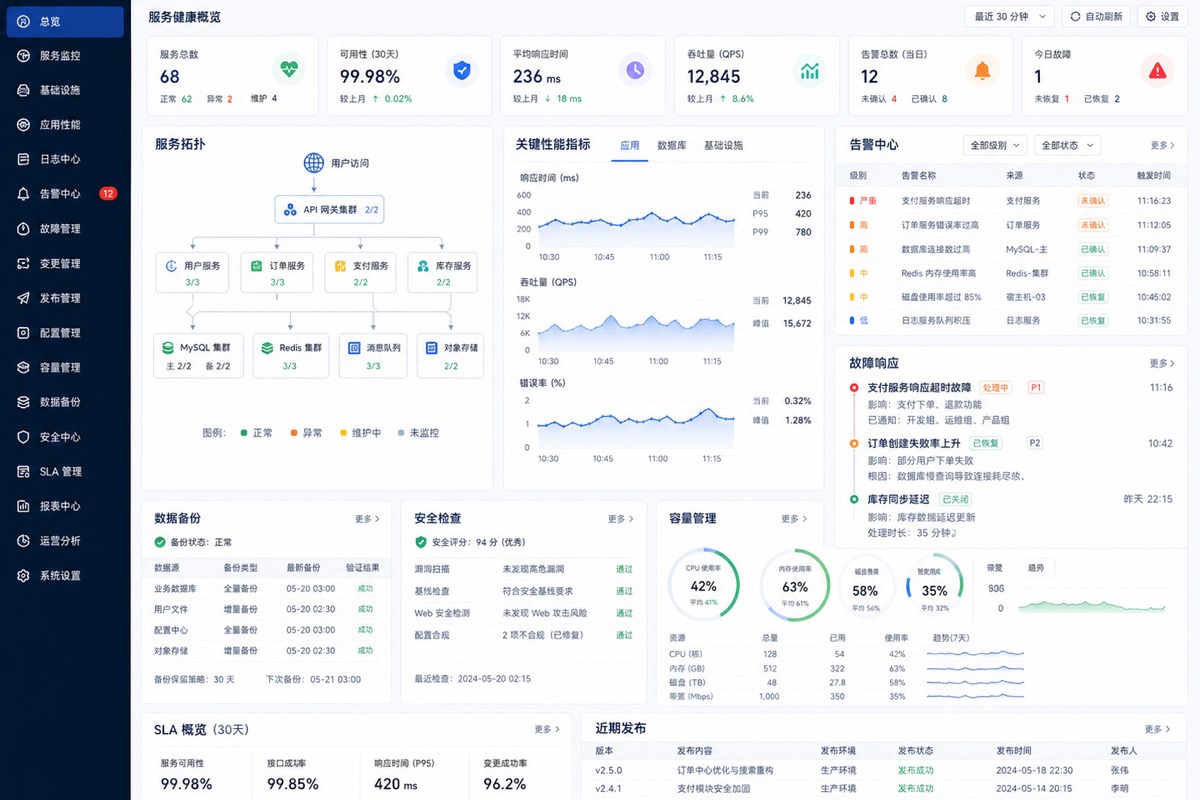
The new team completes the asset and operational risk diagnosis before taking over, and establishes the transition period based on the buildable, releaseable, removable and recoverable state.
The level of uncertainty is reduced by stages before deciding on the scale of inputs and the modalities of cooperation.
Inventory code, server, database, account number, dependency, backup, log and known problems.
Complete deployment, alarm, backup validation, emergency contact person and high-risk rehabilitation.
Business failures, changes, releases, security, capacity, reporting and knowledge transfer.
Historical deficiencies, unknown codes, third-party platforms, cloud failure and client-side operational responsibilities are to be identified in the takeover report; 7x24 safeguards, on-site support, security-specific and critical needs are not implicitly included in the base transportation.
The system relies on personal experience, and key personnel are not able to handle it without them
No surveillance and recovery of backup, failure detection and positioning too late
Direct online modifications without testing, version and backlog
Untransparent maintenance costs, additional needs and malfunctions to repair border disorder
Codes, environment, accounts, dependency and operational status to take over audit
Application, interface, tasks, logs, capacity and operational availability monitoring
Backup recovery, release retreat, renewal of certificates and security updates
Fault classification, response disposal, root analysis and problem reset
Disable, small version iterative, performance and stability optimization
SLA, help desk accounts, monthly reports and knowledge case construction
The service boundaries, budget bases and modalities of implementation for different phases of the project are not identical and can be further assessed in conjunction with the following.
The final delivery boundaries are defined according to the scope of services, the construction phase and the modalities of cooperation, and are described below as common results.
Service coverage and business closed loops that must be completed in the first phase: code, environment, account number, dependency and operational status to take over audit, applications, interfaces, tasks, logs, capacity and operational availability monitoring
Level of integrity of existing codes, data, systems, equipment and documents, and scope of coverage to be audited, relocated or re-engineered
Number of third-party interfaces, coordination responsibilities, data quality, unusual compensation and external supplier cooperation
Non-functional requirements such as performance, availability, security, authority, audit, compliance and access windows
Delivery depth and long-term responsibility: release results, test logs and deployment information, monthly traffic reports, SLA and knowledge base, and quality assurance, transport peacekeeping continuum
Project objectives, responsible persons and acceptance criteria are not established
Key accounts, data, interfaces or business authorizations not available
Only the maximum price or very short cycle is sought, and the necessary tests and quality control are not accepted
Description of the technology warehouse, the deployment environment, common malfunctions and operational time periods, we first check the transfer of information, response levels, release authority and back-up recovery requirements.
The following are used to explain the implementation methodology, the data calibre and the boundaries of responsibility, and are not used as a proxy for project judgement by functional lists.
When the project is launched, a business chain is selected that needs most improvement, interviews the actual user and takes up a recent sample. The volume of records processed, average time-consuming, waiting time, number of returns, unusual numbers and manual contact points around “Codes, Environment, Account Numbers, Dependence and Operation Status” is taken over; if the available data are incomplete, the baseline is used as a manual table account for one to two weeks in a row. Without a baseline, the project can only be completed by evaluating whether the interface is completed and it is not possible to judge whether the outsourcing of software transport and systems maintenance has resulted in sustainable business changes.
The baseline should also indicate the scope of the statistics and exclusions. For example, processing time begins with the availability of information or with the first submission by the client, the exception fails to include third-party interfaces, and manual modifications are minor proofreading or re-processing.
The first phase does not seek to cover all departments, but rather forms a closed loop around “applications, interfaces, tasks, logs, capacity and operational usability monitoring” that can operate in real terms: clear input, rules of handling, system actions, responsible roles, abnormal movements and final output. Key roles include at least business owners, actual users, technical interfaces and acceptance managers, avoiding demand being described by management and being used on the Internet only by another group.
The need assessment corresponds each competency to the business scene, user role and sample acceptance. Matters that do not provide legitimate data, interfaces or decision makers should be included as a pre-condition or subsequent stage, and should not be included quietly in a fixed-range offer.
The typical path is limited takeover and risk diagnosis, restoration of build deployment and backup validation, establishment of a monitoring and alert and response mechanism, and stabilization of transport and version management. Each stage should result in identifiable results, such as flow charts, prototypes, interface contracts, test records, deployment instructions or running demonstrations.
The stage demonstration is not “looks fit to work”. A representative sample should be used to cover normal processes, missing fields, repeat requests, inadequate authority, time overruns and historical data anomalies from external services, and to identify problems that arise only in the production environment at an early stage.
The project should at least reconcile the system assets, the dependency and risk take-over list, monitoring, alarm, backup and recovery programmes, issuance, change, retreat and contingency planning, and confirm the source code or configuration attribution, account management, build deployment, data backup, failure response and subsequent maintenance responsibilities. In addition to functional acceptance, it should also check the rights, security, performance, logs, recoverability and training of key users to ensure that client teams are able to use and understand the system boundaries independently.
Assuming a process baseline of 800 items per month, an average of 18 minutes per unit, and a return rate of 12 per cent, this is only an example, not a client’s performance. A line should be followed by four to eight consecutive weeks of continuous observation at the same calibre, then a judgement that the system failure is detected, released and restored earlier, more manageable and more transparent.
This page contains organizational content around real service issues such as software-based outsourcing, system maintenance outsourcing, IT-based outsourcing, application-based system delivery. Keywords are used to help users and search systems identify themes, without implying a commitment to fixed effects; final scope, cycle, budget and indicators are based on project diagnostics, contracts and acceptance baselines.
Each stage has clear objectives, participatory roles and assessable outcomes, and important decisions are not left to the end of the project.
The most common issues before cooperation are clearly stated in advance.
Quality assurance usually only fixes the deficiencies within the accepted range, and the operational aspects also include monitoring, backup, failure response, environmental maintenance, third-party change and ongoing version management.
The unknown system usually takes over diagnosis and does not immediately commit to fixing the SLA.
A distinction should be made between incident management, deficiency repair, routine maintenance and needs iterative. Small changes may be included in the work-hour package, with larger needs being assessed separately.
SLA should first distinguish the level of failure by business impact, then agree separately on the objectives of receiving, responding, bypassing, restoring and root cause analysis. Response time does not equal the time of repair, and third-party platforms and client collaboration are written out.
View full answerAI consultancy, MCP integration, technology outsourcing and systems deliveryThe first step is to preserve existing assets and backups, without direct modifications in the production environment. The construction or at least restoration of operational dependence is then restored, and core processes, data, security and third-party interfaces are checked. Until the unknown range is confirmed, only the phase plan and risk budget are given, and it is not appropriate to commit to full fixed prices or strict SLAs.
View full answerContracts, payments, changes and project deliveryThe term is not uniform and is determined by system importance and contractual agreement. The parties also specify the response time, the level of deficiency and the service after the quality assurance has been completed.
View full answerBusiness Info, Systems integration and TransportThe service is based on system importance, time frame for use, data sensitivity and external dependence. The service is not just waiting for the press barrier, but also continuously observing performance, error, cost and operational anomalies.
View full answerPreserve assets and restore buildable, publishable and preserveable states
For more information.Maintenance guideUnderstanding the cost implications of system complexity, SLA, environment and iterative scope
For more information.Cost guidelinesEstimating inputs by taking over risk, security time, response level and version
For more information.Description of systems technology warehouse, current malfunctions, mode of dissemination and business continuity requirements, first checking the conditions for takeover, response range and maintenance of the boundary.
The first contact is not to send passwords or unsensitive sensitive information.