Home / Solutions / Manufacturing Increased Manufacturing and Smart Manufacturing Solutions
BUSINESS SOLUTION

Smart Manufacturing

The orders performance connection plan and site provide management with clear progress, anomalies, quality and cost, and evolve into replicable production management mechanisms.

Transparency of production progressIt's a lot faster than that.Inventory and planned synergyQuality processes traceable
Integrated platform for the production of stock of manufacturing firms ' orders
Direct findings

Principles for implementation of smart manufacturing

The informationization of manufacturing should be carried out from a key chain between the order and delivery, by harmonizing basic data such as materials, processes, worksheets and inventories, and by moving forward with on-site reporting, quality traceability and equipment connectivity. ERP, MES and the equipment platform have different responsibilities, and it is not appropriate to replace the whole management with a single system.

FIT & BOUNDARY

Application of scenes and enforcement of boundaries

The question is first determined whether the issue is suitable for resolution through this programme, and then the scope of the construction and the pace of inputs.

Operational challenges

Unsynchronized planning, production and inventory information

On-site reporters rely on paper or manual aggregation

Late detection of quality problems, difficulties of retroactive

Equipment data not linked to business orders

Programme capacity module

01

Sales orders and demand plans

02

Procurement, materials and inventory

03

Production, work orders and live reports

04

Quality testing, AI visual inspection and traceability

05

Access to equipment and unusual alarms

06

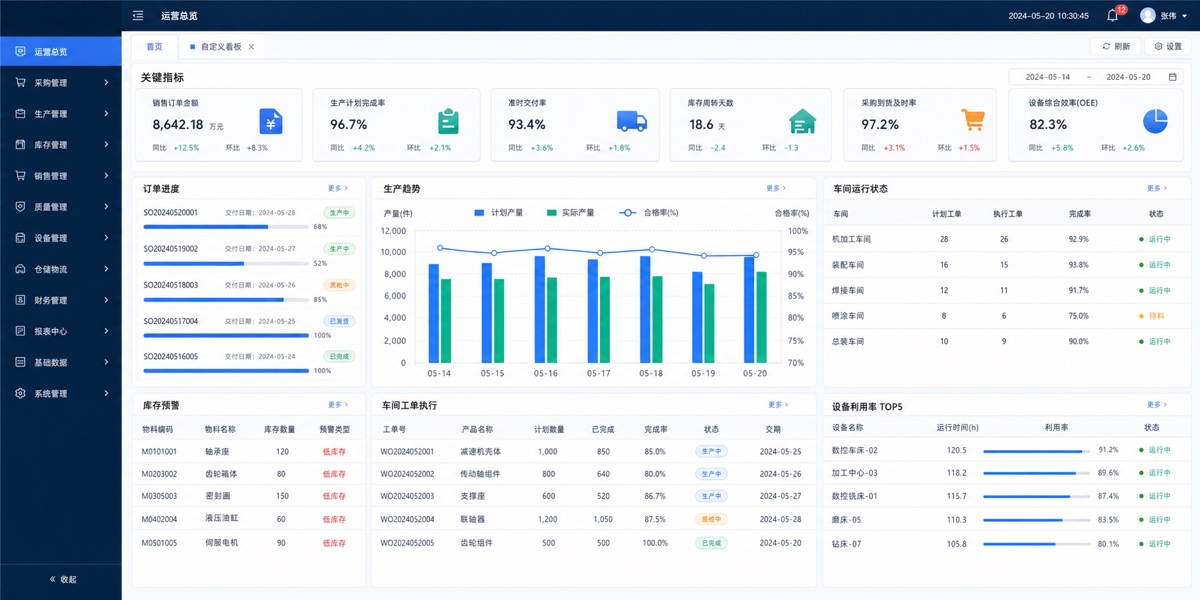
Production operating cockpit

Proposed programme structure

The architecture level will be tailored to existing systems, data conditions and first-phase targets, with a focus on ensuring that business, data, integration and operational responsibilities are closed.

Business and Planning Level

(c) Carrying sales orders, demand plans, procurement and business objectives, with clear priority being given.

Production Executive Level

Management of work orders, de-production, assignment, newspaper, work in progress and abnormally closed loops.

Quality and traceability

Recording of the material, process, finished product examination and batch, serial number and problem disposal.

Devices and Margins

Access to equipment status, production, alarm and key process data by business value.

Data and Isolation Layers

Connect ERP, WMS, PLM and establish production indicators and competency audits.

Boundary of responsibilities and collaboration between the parties

ZhiHua Tech for business blueprints, systems architecture, platform development, equipment or systems interface, testing and on-line support

The head of the enterprise ' s production, planning, quality and warehousing confirms the rules of the process, the underlying data and the responsibility for the disposal of anomalies

Provision of agreements, interfaces, environment and on-site communication conditions by suppliers of equipment and inventory systems

The parties jointly selected representative production lines or workshop pilots, which were then distributed in batches after the site was collected

Programme delivery results

SOLUTION OUTPUTProduction business blueprint
SOLUTION OUTPUTMES or production synergy platform
SOLUTION OUTPUTEquipment interface and acquisition programme
SOLUTION OUTPUTQuality traceability system
SOLUTION OUTPUTProduction analysis board

Verifiable delivery evidence

(b) Retain reversible and accessible engineering materials at each stage, without oral representations in lieu of acceptance.

DELIVERY EVIDENCEOrders to delivery flowchart and role matrix
DELIVERY EVIDENCEMaterial, process, worksheet and quality data dictionary
DELIVERY EVIDENCEERP, interfaces and interfaces and linkage records
DELIVERY EVIDENCEPilot workshop UAT, training and closure list
DELIVERY EVIDENCEOnline surveillance, data reconciliation and emergency repatriation programme

Recommended acceptance and inspection baseline

01

Representative orders are fully tracked from planning, production, quality control to inventory

02

Checks completed with key reporters, inventory and quality data and agreed sources

03

Equipment offline, duplicate data and interfaces are abnormally equipped with alarms and reimbursement processing

04

The role on the ground can be stabilized under agreed terminals and networks.

05

Management indicators can be drilled down to worksheets, batches or liability lines and can be interpreted as calibrated

SCENARIO WALKTHROUGH

Smart manufacturing implementation drill

A quantifiable capability scenario is used to describe how problems are defined, programmes designed and production acceptances completed.

Site Start

First, we'll deal with the one link that most affects business.

Assuming that an enterprise first encounters “not synchronized planning, production and inventory information”. The project team does not directly purchase tools, but selects the real tasks of the immediate future, recording monthly processing volumes, average waiting and processing times, a single completion rate, manual revision rates, unusual types and responsible departments. The figures must be from systems records or manual samples that can be reviewed by the client; short-cycle accounts are created when information is insufficient, not for the purpose of creating a fictional ROI.

How the indicative list should be designed

The following figures are used only to demonstrate measurement methods: if the original process handles 1,200 tasks per month, waits an average of 6 hours, actually processes 12 minutes, manual returns a rate of 15 per cent, the first target can be defined as “a 30 per cent reduction in waiting time, a 20 per cent reduction in manual processing time and a return rate not higher than the original baseline.” The receiving and inspection process provides both original samples, statistical queries and an unusual list. If the processing volume, business rules or sample difficulty changes significantly, the processing should be re-corrected and not just a good-performing date should be chosen to reach a conclusion.

The role privileges, historical data, external interfaces, capacity, security, backup and back-up checks should also be completed before official access. The first observation cycle after the line is run by the head of operations: check the real rate of adoption and then analyse the reasons for non-use, manual modification and mission failure. Only if the user continues to use and the quality floor does not decline will improvements in efficiency or performance indicators be of interpretive value.

DELIVERY PATH

From diagnosis to continuous operation

Each stage has clear objectives, participatory roles and assessable outcomes, and important decisions are not left to the end of the project.

01Order performance diagnosis
02Basic data governance
03Online at the production site
04Equipment and system connectivity
05Indicator optimization
FAQ

FAQs

The most common issues before cooperation are clearly stated in advance.

Should the manufacturing company go to ERP or MES?+

ERP focuses on resource and business management, and MES focuses on implementation at the production site. Orders should be made to the key link to delivery, based on current core issues and established systems.

Can old equipment be accessed?+

Equipment protocols, controllers, networks and data quality need to be assessed and progressively accessed through gateways, margin collection or manual aids.

Can I get an A.V.?+

It is possible, but first, to confirm the definition of defects, camera light sources, spot rhythms and representative samples, then to verify key deficiencies through the PoC, error, speed and quality.

DECISION FAQ

Common issues related to current projects

Check out all 265 questions.
Corporate information selection, integration and data governance

How should data inconsistencies in multisystems be addressed?

The client, commodity, organization, inventory and order may be the primary responsibility of the different systems, with clear coding, calibration, synchronization and timing. Historical differences require an inventory, cleansing and manual validation, and no batch script can be used to conceal the root causes.

View full answer
AI System Transport, VoiceAgent and Visual Recognition

How many pictures do I need for the A visual recognition project and how do I get the data?

Visual projects do not apply to the fixed number of images in all scenarios, and representation is usually more important than simply stacking. Data need to cover different devices, light, angle, batch, background, normal categories and rare anomalies.

View full answer
One-man company and OPC technical support

Does a company need a CRM, project management and knowledge base?

Whether or not information is complex is not the number of companies. When clients exceed memory control, the project has multiple nodes, and the programme needs to be reused, the corresponding system should be put in place; but the three capabilities need not be provided by three heavy platforms.

View full answer
One-man company and OPC technical support

How should data be integrated when dispersed using multiple AI tools?

First, identify the primary data system of clients, projects, contracts and knowledge, then position other AI tools as callers or processors, rather than keep a single primary record for each tool. Prioritize the use of official API, Webbook or regular export of synchronized fields, and harmonize customer and project identification. For unexportable closed tools, the risk of migration should be assessed and the critical business assets avoided.

View full answer