
What difference does AI work between AI and AI Agent?
It is not appropriate to enter the full project directly without the real task and responsibility.
For enterprises preparing for AI workflows, describe process selection, nodal division, cross-system organization, manual approval, cost boundaries, abnormal retreats and production acceptance methods.
Enterprise AI workflows should start with a process that is high-frequency, clearly outputed, timed manually and can be measured and error-ridden. The certainty rules are responsible for stabilizing steps, AI nodes for document and semantic processing, high-risk actions are maintained for manual validation and enter production operations through permissions, logs, retests, retreats and continuous evaluation.
The topic is not a collection of articles, but a decision-making path from problem identification, programme selection and project acceptance.
It is not appropriate to enter the full project directly without the real task and responsibility.
The ICP is harmonized in terms of scope, data, interfaces, privileges, quality and transport. Each conclusion is required to describe assumptions and exclusions and to avoid comparing only the number of functions or a total price without a boundary.
Select a representative sample to validate normal, unusual and boundary tasks, while recording quality, processing time, manual intervention, running costs and consequences, creating a repetitivable basis for decision-making.
The up-line acceptance and inspection should reconcile delivery, engineering evidence and operational indicators, and clarify account numbers, data, source code, configuration, documentation, training and subsequent operational responsibilities, enabling the enterprise to maintain its capacity to use and take over.
The first reading allows for entry into the articles closest to the current problem, and the compilation of terms, risks and candidate paths; the preparation of items is followed by a review of the corresponding service pages, solutions and competency cases, bringing in the volume of business, sample, existing systems, budget levels and planning time.
The sample data that appear on the theme page are used to explain the method and do not represent the results of a particular client. The enterprise should establish its own baseline before the project begins and agree on the statistical scope, data sources and observation cycle.
Complete methodology built around business value, nodal design, system connectivity and acceptance operations.
Priority is given to tasks with high levels of duplication, adequate sample size and reviewable results, while recording current processing, average time consumption, error rates and backlogs as a baseline against which the PoC is compared to the line.
Identification of process owners and outcome users
Write down normal, unusual and non-automatic matters
Value judged by time-saving, quality or transformational indicators
Trigger, field verification and status flow uses certainty procedures to the extent possible; semantic tasks such as classification, extraction, summary and generation are given to AI; irreversible actions such as payment, promise and official issuance are confirmed by authorized personnel.
Each node defines input, output and timeout
Create a real sample assessment for AI nodes
Set minimum privileges and approvals for high-risk actions
Linking CRM, ERP, OA, worksheets and information tools requires processing of identity maps, swipes, retesting, compensation and data reconciliations to avoid the more subtle data inconsistencies that would result from the automation of processes.
Distinguishing data primary responsibility system from synchronized direction
Recording of each call and state change from interface
Provide manual processing stations and failed regression paths
The acceptance and inspection, which is not just a successful demonstration, should cover normal, unusual and border samples and check the rights, audits, stability, running costs, manual intervention rates and operational improvements.
Fixed sample sets can be repeated.
Process version, log and results can be tracked
Continuous observation of quality, cost and operational indicators after going online
From business judgement, methodological design to project delivery, a complete understanding of the problem is gradually being developed.
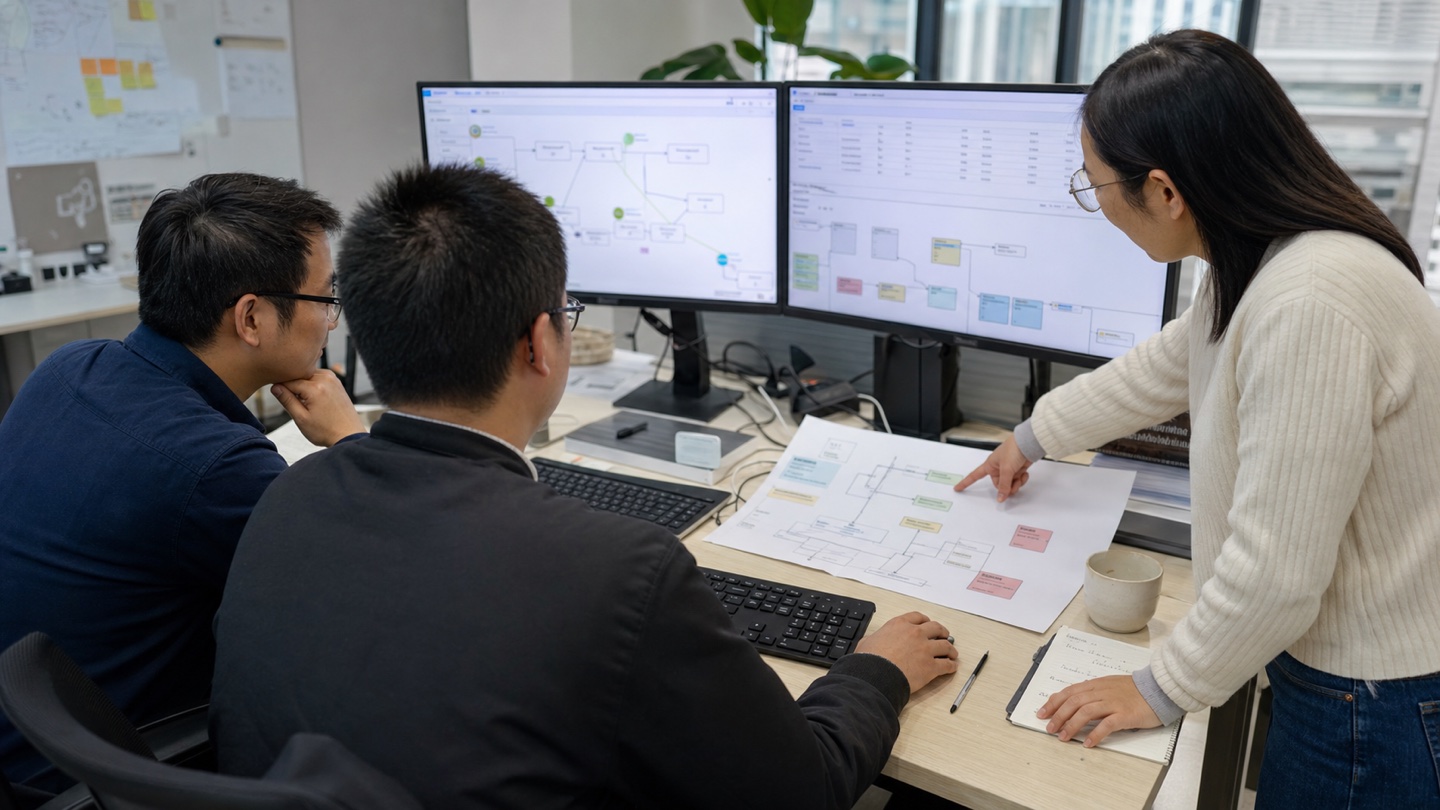
The system describes the working-stream approach of enterprise AI: select processes suitable for automation, design AI nodes, rules, manual approvals and system interfaces, and complete production go-live through abnormality compensation, auditing and indicators.
Continued examination of the structure, delivery and implementation experience relevant to the topic.
Procurement methods from business closed loops, team capacity, bid contracts to production evidence
For more information.Agent Engineering PracticeComparison of collaborative approaches and border management that drive Agent and the definitive workflow
For more information.System Connection PracticeBuilding interfaces, messages, tungsten, retesting and abnormality compensation capabilities for cross-system workflows
For more information.AI Implementation PracticeClosed loops from PoC, real assignment assessment, competency audit and production operations
For more information.Most enterprises do not need to replace existing ERPs, CRMs or RPAs, which can be used as business primarys to connect AI workflows through API, news, read-only data services, file exchange or controlled RPAs. AI is responsible for documentation understanding, classification, summary and recommendation, certainty procedures for field verification and status, and the existing system continues to maintain official business data.
View full answerAutomation engineering, automation outsourcing and AI automation specialistsAutomation works are a more complete project concept that typically covers process diagnostics, rule procedures, AI nodes, systems interfaces, competencies, anomalies, monitoring, deployment and continuous operation. AI workflow is one way of achieving this, highlighting how the task is triggered, through which nodes, when approvals and how they end.
View full answerenterprise AI Effectiveness, Safety and Continued OperationThe normal workflow is suitable for processes with clear rules and fixed paths, and the RPA is good at operating desktops or web-page systems without interfaces. AI Agent is suitable for tasks that require understanding of natural languages, selecting tools and processing uncertain information. The three are not a substitute relationships, and are frequently used in combinations. The selection should look at process stability, interface conditions, consequences of errors and review requirements.
View full answerEnterprise context engineering, model migration and process intelligenceProcess mining is used to discover how operations actually work, where work is waiting and what variations cause losses; AI automation is used to change the steps that fit the machine. When the cause of the problem is not clear to the enterprise, it should diagnose and establish a baseline. When the process is clear, the task is stable and a sample is available, a small-scale automated PoC can be done directly. Not all process issues require AI, and rules, interfaces or management adjustments may be more effective.
View full answerThe thematic content is used to understand problems, professional services and solutions to develop enforceable pathways that combine the current state of the enterprise.
Provides enterprise AI workflow, business process automation and cross-system tasking services, connecting documents, knowledge base, CRM, ERP, OA, worksheets and message tools, covering manual approval, abnormal retreats, audit monitoring and continuous optimization.
For more information.Professional servicesProvides enterprise automation engineering, software automation engineering and AI automation outsourcing services, with process diagnostics completed by artificial intelligence automation specialists, Agent and workflow design, systems integration, abnormal governance, production go-live and continuous operations.
For more information.Professional servicesProvide ERP integration, CRM integration, third-party API integration, and payment, finance, electronic invoicing, logistics, single-point logging and intersystem data synchronization services, and establish a system of controllable and accountable interfaces.
For more information.SolutionsProvide AI transformation planning, scenario mix and data preparation for enterprises and SMEs, implementing large models of the business knowledge base, AI guest service, AI Agent, smart files, AI data analysis, workflow automation and privatization.
For more information.SolutionsConnect ERP, CRM, OA/BPM, HRM, SCM, WMS, MES, PLM, Finance, Cost Control, Logistics, Invoices and Data Platforms through API, synchronisation, Single Point Login and Process Organization.
For more information.