
Takeover and baseline
Confirming the system ' s stabilityInventory codes, models, tips, knowledge, tools, accounts, environment, logs, assessments and existing problems.
After AI is online, models, knowledge, tips, tools, interfaces and business rules continue to change. Enterprises need to manage quality, cost, authority and failure as they manage production software, and maintain manual take-over, version retreat and supplier switching capabilities.
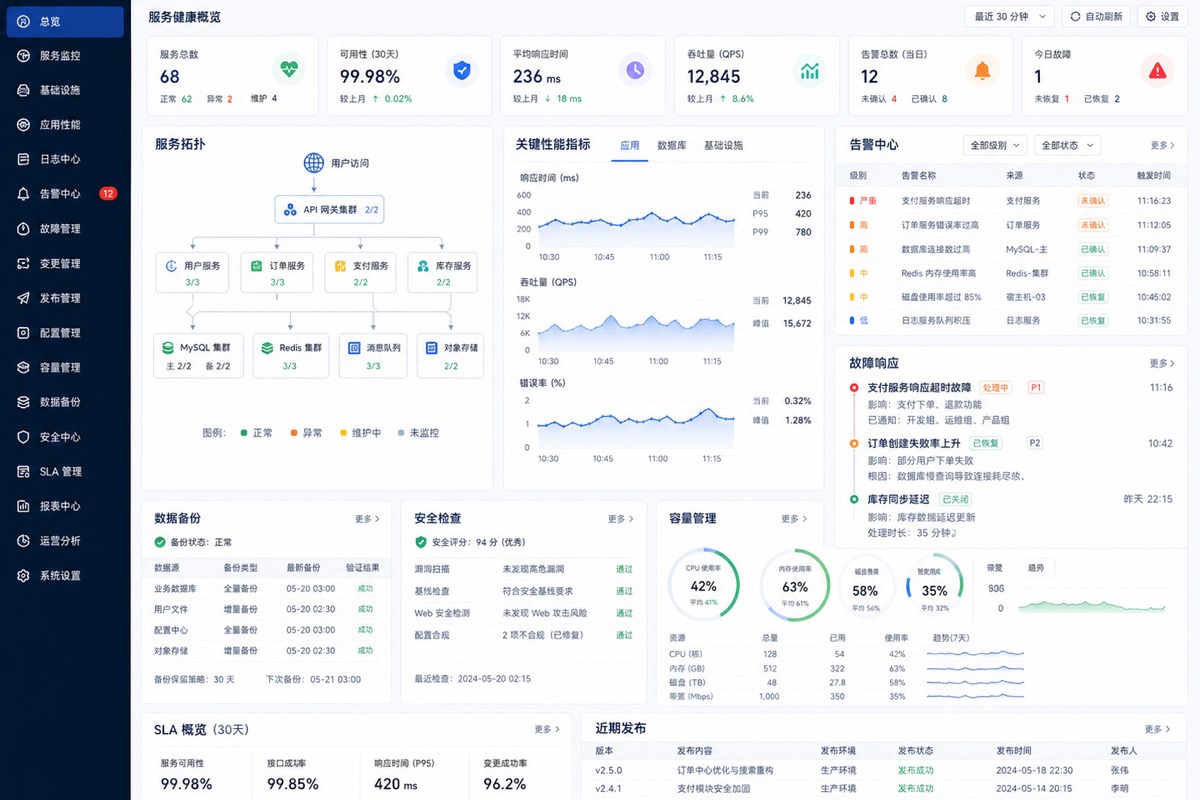
Select an AI application that is already on line or ready to go online, establishing six types of baselines for usability, task quality, manual intervention, delay, call cost and high-risk error. The models, tips, knowledge, tools and codes are then incorporated into the uniform version and release records, enabling operators to detect anomalies, suspend capacity, reverse versions and retest results.
The level of uncertainty is reduced by stages before deciding on the scale of inputs and the modalities of cooperation.
Inventory codes, models, tips, knowledge, tools, accounts, environment, logs, assessments and existing problems.
Access to operational indicators, fixed assessments, cost desk accounts, issuance of door closures, alarms and manual takeovers.
Process bad case, update knowledge, model switching, cost optimization, security events and monthly redisk.
The service focuses on the engineering and quality operations of AI applications, and does not replace legal compliance reviews or professional judgements of client operations. Models API, cloud resources, computing and third-party platform costs are usually based on actual usage.
AI application, AI system, AgentOps, and smart body operations are not a name changer for traditional server monitoring. In addition to availability, continuous observation of mission quality, knowledge freshness, model versions, tools call, manual intervention, call costs and operational results is required, and regression assessments are implemented after change.
The tasks, models, knowledge versions, retrieval, tool calls, delays, costs, errors, manual processing and final operating state are also recorded.
Business input, knowledge, models, tips and external interfaces will change, requiring drift testing, feedback classification, fixed mission return and version roll-back.
The single effective mission cost is measured by business scene, optimized through model route, cache, context governance and failure, and not only token unit prices.
First take stock of source code, account number, model, knowledge, assessment, interface, deployment, monitoring and failure history, and then establish operational baselines and high-risk recovery plans.
Monitor the server only if it's online, not knowing if the answer and the task quality are down.
The tips, knowledge, models and tools are scattered and problems on the line are difficult to recover
Lack of switching and downgrading options when suppliers limit flow, interface changes or lower line of models
Error feedback, manual modification and business complaints not entered the continuous evaluation closed loop
Model gateway, route, restricted flow, cache, downgrade and supplier switching design
AI Observability, Agent task level transfer chain, tools and manual take-over tracking
RAG knowledge acquisition, version, index updating, failure and quality re-examination
Offline gold collection, version regression, online sampling and bad case closed loop
AI FinOps, Token, Calculator, Retrieving, Tool and Manual Review of Full Cost Governance
Audit of authority, alerting, sensitive information monitoring and incident response
The service boundaries, budget bases and modalities of implementation for different phases of the project are not identical and can be further assessed in conjunction with the following.
The final delivery boundaries are defined according to the scope of services, the construction phase and the modalities of cooperation, and are described below as common results.
Service coverage and business closed loops that must be completed in the first phase: model gateway, route, restricted flow, cache, downgrade to vendor switching design, AI observability, Agent task-level transfer chain, tools and manual take-over tracking
Level of integrity of existing codes, data, systems, equipment and documents, and scope of coverage to be audited, relocated or re-engineered
Number of third-party interfaces, coordination responsibilities, data quality, unusual compensation and external supplier cooperation
Non-functional requirements such as performance, availability, security, authority, audit, compliance and access windows
Delivery depth and long-term responsibility: cost desk accounts, optimization recommendations and monthly operational reports, failbacks, knowledge updates, manual for release and take-over, and quality assurance, peacekeeping continuity ranges
Project objectives, responsible persons and acceptance criteria are not established
Key accounts, data, interfaces or business authorizations not available
Only the maximum price or very short cycle is sought, and the necessary tests and quality control are not accepted
The following are used to explain the implementation methodology, the data calibre and the boundaries of responsibility, and are not used as a proxy for project judgement by functional lists.
When the project starts, select a business link that needs most improvement, interview the actual user and take recent samples. Record processing, average time-consuming, waiting time, back-to-work, unusual numbers and manual contact points around the Model Gateway, route route, restricted flow, cache, downgrade and vendor-to-switch design. If the available data are incomplete, the baseline is used as a manual billboard for one to two weeks in a row. Without a baseline, the interface can only be evaluated for completion and it is not possible to judge whether AI system transport and AgentOps are bringing about sustainable business changes.
The baseline should also indicate the scope of the statistics and exclusions. For example, processing time begins with the availability of information or with the first submission by the client, the exception fails to include third-party interfaces, and manual modifications are minor proofreading or re-processing.
The first phase does not seek to cover all sectors, but rather forms a closed loop around “AI detectability, Agent task level transfer chain, tools and manual take-over tracking” that can operate in real time: clear input, processing rules, system actions, responsible roles, unusual movement and final output. Key players include at least business owners, actual users, technical interfaces and receiving and inspection managers, avoiding demand being described by management and being used on the Internet by another group.
The need assessment corresponds each competency to the business scene, user role and sample acceptance. Matters that do not provide legitimate data, interfaces or decision makers should be included as a pre-condition or subsequent stage, and should not be included quietly in a fixed-range offer.
A typical path is to take inventory of AI applications and production responsibilities, establish a baseline for quality costs and operations, access monitoring logs and fixed assessments, and configure door-to-door bans and abnormal reversals. Each stage should result in visible results, such as flow charts, prototypes, interface contracts, test records, deployment notes or running demonstrations.
The stage demonstration is not “looks fit to work”. A representative sample should be used to cover normal processes, missing fields, repeat requests, inadequate authority, time overruns and historical data anomalies from external services, and to identify problems that arise only in the production environment at an early stage.
The project should at least check the AI application asset, version, liability and risk takeover list, AgentOps control alarm, operating board and SLA programs, models, RAG and Agent fixed regression assessment, and confirm the source code or configuration attribution, account management, build deployment, data backup, fail response and follow-up maintenance responsibilities. In addition to functional acceptance, check access, security, performance, logs, recoverability and key user training to ensure that client teams are able to use and understand the system boundaries independently.
Assuming a process baseline of 800 items per month, an average of 18 minutes per unit, and a return rate of 12 per cent, this is only an example, not a client’s performance. A line should be followed by four to eight consecutive weeks of continuous observation at the same calibre, before judging whether or not to achieve changes in AI quality are detected earlier, the problem can be located in a specific version, the reasoning and the labour costs are more transparent.
This page contains organizational content around real service issues such as enterprise AI, AgeOps, LLMOps, and AI. Keywords are used to help users and search systems identify themes, without signalling a commitment to fixed effects; final scope, cycle, budget and indicators are based on project diagnosis, contract and acceptance baselines.
Each stage has clear objectives, participatory roles and assessable outcomes, and important decisions are not left to the end of the project.
The most common issues before cooperation are clearly stated in advance.
The model provider, knowledge content, business systems and user issues will change, and the initial acceptance will only support the current version.
Traditional traffic is concerned with availability, capacity, logs and publishing; AgentOps also manages models, tips, knowledge, tools, task completion rates, manual takeovers and assessment collections. The two need to be combined, not replaced.
A takeover diagnosis can be done first. If the existing system has a legitimate mandate, a observable log, a reconfigurable configuration and a re-deployment capability, it can be established to operate on the original structure; major structural issues will be proposed separately.
The AI application maintenance is not just a check that the server is online, but also manages models, tips, tools, privileges and evaluation versions. The operating team needs to observe mission quality, manual intervention, error type, delay and call cost. The model or knowledge is updated and then retests and records are maintained on the fixed task set.
View full answerAI System Transport, VoiceAgent and Visual RecognitionThe LLMOps further manage models, data, tips, assessments and reasoning resources. AgentOps also focuses on tools, task status, authority, manual takeovers and business completion. The Enterprise AI system is usually needed in three ways, and cannot replace basic software engineering with new terminology.
View full answerAI System Transport, VoiceAgent and Visual RecognitionCost optimization should be done without loss of quality and risk, and should be improved by modeling, context management, cache and task limit. Ultimately, the cost of a single effective mission should be compared with the minimum token unit price.
View full answerAI Digital Employees, Multi-Intelligence, Security and Enterprise Intelligence SearchBesides whether or not the service is online, you have to link users, Agent, models, tips, knowledge retrieval, tool calls, status changes, errors, manual modifications, delays, Token costs and end results in a business assignment. The goal is not to save chat content indefinitely, but to make the issue recreateable, version comparable, cost explained. Sensitive logs must be dissensitized, decentralized and set retention periods.
View full answerCheck quality, safety, greyscale, retreat, surveillance and manual takeover capacity
For more information.SLA GuideDefinition of responsibility for response, recovery, upgrading, duplication and continuity of operations
For more information.Project questions and answersUpline boundary from review, testing, safety, dependence and maintenance
For more information.Quality governanceEstablishment of risk classification, assessment and measurement, issuance of door-to-door bans, authority and manual takeover mechanisms
For more information.Software TransportComplete production environment, backup, distribution, failure response and basic SLA
For more information.Cost guidelinesEstimated inputs by application, model links, frequency of assessment, SLA and operating depth
For more information.