
Current situation diagnosis
Establish operational objectives, status baselines and binding listsInterviews with management and actual positions to check processes, volume of processing, data, systems, competencies and current AI pilots.
The Enterprise AI Transport should not start with a procurement model or a listing tool, but should first identify the business tasks that really affect income, costs, delivery and risk, reconcile data and system conditions, and then form a phased, verifiable and stopable AI implementation route.
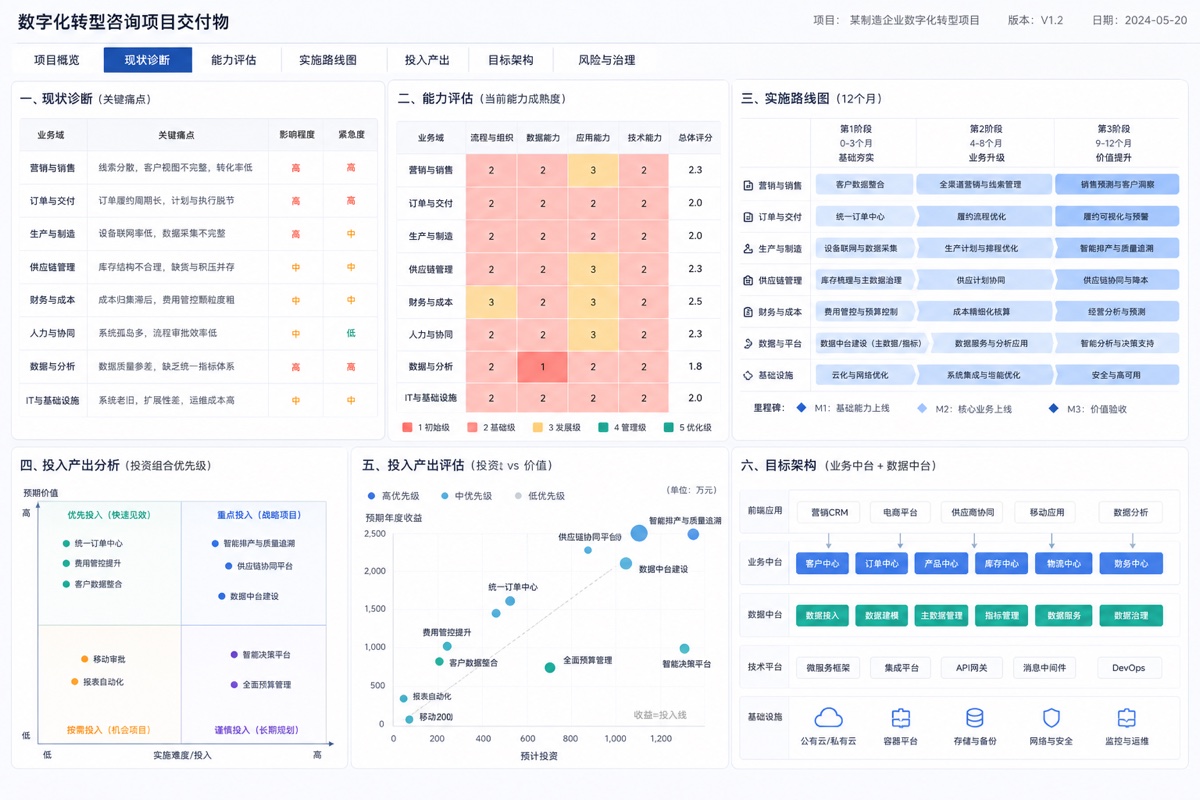
It is recommended that a limited set of AI opportunity diagnostics be completed, that three to ten candidate scenarios be compared with the same set of ratings, and that a well-valued, sample-available, and error-controlled task be selected for the PoC. The PoC is adopted before the production system is fully completed, interfaces, monitoring and operating, and that it avoid jumping from demonstration to a wide-ranging online.
The level of uncertainty is reduced by stages before deciding on the scale of inputs and the modalities of cooperation.
Interviews with management and actual positions to check processes, volume of processing, data, systems, competencies and current AI pilots.
Samples, indicators, budgets and conditions for discontinuation are rated by value, feasibility, risk and reuse.
Planning interfaces, deployment, authority, assessment, manual takeover, operational role and 3 to 12 months of route.
Counselling is based on information provided by clients and allowed to be used, and is not a substitute for legal, audit or industry certification; impact projections must be based on the assumption that the official business proceeds will be measured at the same calibre after implementation.
AI has a lot of ideas, but it's not possible to judge which one to start with and why.
Different values are used by business, IT and management
Data, interfaces and privileges were not exposed until later in development
The PoC demonstration was very effective, but there was no production and operational responsibility.
Enterprise AI maturity, business processes and existing systems
AI scene discovery, value assessment and priority combination design
Assessment of data readiness, model routes, interfaces and deployment modalities
PoC scope, mission sample, evaluation indicators and discontinuation design
AI governance, authority, security, manual takeover and operational responsibility planning
Phased budget, implementation of road map and vendor technical programme evaluation
The service boundaries, budget bases and modalities of implementation for different phases of the project are not identical and can be further assessed in conjunction with the following.
The final delivery boundaries are defined according to the scope of services, the construction phase and the modalities of cooperation, and are described below as common results.
Service coverage and business closed loops that must be completed in the first phase: enterprise AI maturity, business process and existing systems diagnostics, AID scene discovery, value assessment and priority portfolio design
Level of integrity of existing codes, data, systems, equipment and documents, and scope of coverage to be audited, relocated or re-engineered
Number of third-party interfaces, coordination responsibilities, data quality, unusual compensation and external supplier cooperation
Non-functional requirements such as performance, availability, security, authority, audit, compliance and access windows
Delivery depth and long-term responsibility: 3 to 12 months of AI transition implementation road map, budget levels, risk list and decision evaluation materials, and quality assurance, peacekeeping continuity range
Project objectives, responsible persons and acceptance criteria are not established
Key accounts, data, interfaces or business authorizations not available
Only the maximum price or very short cycle is sought, and the necessary tests and quality control are not accepted
The following are used to explain the implementation methodology, the data calibre and the boundaries of responsibility, and are not used as a proxy for project judgement by functional lists.
When the project is launched, a business chain that needs most improvement is selected, interviews with the actual user and recent samples are taken. The processing volume, average time-consuming, waiting time, back-work, unusual numbers and manual contact points are recorded around “enterprise AI maturity, business process and existing systems”; if the available data are incomplete, the baseline is used as a manual table account for one to two weeks in a row. Without a baseline, only the interface can be evaluated for completion after the project is completed and it is not possible to judge whether the enterprise AI consultation and transformation planning will bring about sustainable business changes.
The baseline should also indicate the scope of the statistics and exclusions. For example, processing time begins with the availability of information or with the first submission by the client, the exception fails to include third-party interfaces, and manual modifications are minor proofreading or re-processing.
The first phase does not seek to cover all sectors, but rather forms a closed loop around “AI scene discovery, value assessment and priority combination design” that can operate in real terms: clearly enter, process rules, system actions, responsible roles, abnormal movements and final output. Key roles include at least business owners, actual users, technical interfaces and receiving and inspection officers, avoiding demand being described by management and being used on the Internet only.
The need assessment corresponds each competency to the business scene, user role and sample acceptance. Matters that do not provide legitimate data, interfaces or decision makers should be included as a pre-condition or subsequent stage, and should not be included quietly in a fixed-range offer.
A typical path is management ' s objective and operational issues interview, process sample, system data and risk inventory, joint rating of the value and feasibility of the scene, first set of PoC and production route design. Each stage should result in visible results, such as flow chart, prototype, interface compact, test logs, deployment description or running demonstration.
The stage demonstration is not “looks fit to work”. A representative sample should be used to cover normal processes, missing fields, repeat requests, inadequate authority, time overruns and historical data anomalies from external services, and to identify problems that arise only in the production environment at an early stage.
The project should at least reconcile the status and opportunity diagnostic report, the AIS scene list, the rating model and priority maps, the data, systems, models and governance gap list, and confirm the source code or configuration attribution, account management, build deployment, data backup, failure response and subsequent maintenance responsibilities. In addition to functional acceptance, check privileges, security, performance, logbooks, recoverability and key user training to ensure that client teams are able to use and understand system boundaries independently.
Assuming that a process baseline is 800 items per month, an average of 18 minutes per unit, and a return rate of 12 per cent, this is only an example, not a client's performance. Achieving better sequencing of AI investments, resonability of the PoC target, and alignment of technology with operational responsibilities should be observed over four to eight consecutive weeks after going online.
This page contains organizational content on real service issues such as enterprise AI, Enterprise AI Transport, AI scenario planning, and AIDPL. Keywords are used to help users and search systems identify themes without signalling commitment to fix effects; final scope, cycle, budget and indicators are based on project diagnosis, contract and acceptance baseline.
Each stage has clear objectives, participatory roles and assessable outcomes, and important decisions are not left to the end of the project.
The most common issues before cooperation are clearly stated in advance.
In addition to systematic planning, the consultancy requires the establishment of judgements around mission samples, model quality, data authorization, manual takeovers, ongoing evaluation and reasoning costs, and not just the output of traditional architecture.
The consultancy should be delivered independently of the scene, route, risk and the PoC Job Letter. The enterprise can execute, re-purchase or suspend the project if the conditions are inadequate.
The consultation distinguishes between data available, data that need to be managed, data that are temporarily unavailable and data that must be validated through short-term collection.
The final results usually include a status diagnosis, a landscape priority, data system gaps, a PoC task letter, an evaluation indicator, a risk list and a phased road map. Each conclusion should be based on a statement of the basis, assumptions and items to be validated. The report should also be used by the enterprise to develop internal projects, compare suppliers and organize follow-up checks and inspections.
View full answerAI consultancy, MCP integration, technology outsourcing and systems deliveryThe first projects should be valued, technically well and manageable. The scene is not a one-time table, and the PoC results and changes in operations are readjusted.
View full answerEnterprise AI Transport Organization and ImplementationThe first scenario should satisfy clear business values, high mission frequency, sample availability, results assessability, system reliance on controllability and error to allow manual bottom-up. Knowledge retrieval, passenger service aids, document extraction, offer preparation, worksheet summaries and low-risk analysis are usually more appropriate for the first stage than for full-automatic decision-making.
View full answerenterprise AI Effectiveness, Safety and Continued OperationThe ROI of the enterprise AI project cannot measure only the mobilization costs of models, nor can it be measured by the “how many people saved”. It is important to record the time of the current process, the time spent on error, the response time, the opportunity lost and the compliance costs, and to compare the real changes after AI has been online.
View full answerBuild scale routes from scenes, data, systems, organization and operation
For more information.Independent diagnosisLimiting scope to check scene values, data base, modeling routes and governance boundaries
For more information.Cost guidelinesEstimated inputs by diagnostic range, sector of participation, number of scenes and depth of route
For more information.