Home / Solutions / Enterprise Digital Platform and Business Mid-Pilot Solutions
BUSINESS SOLUTION

Enterprise Digital Platform

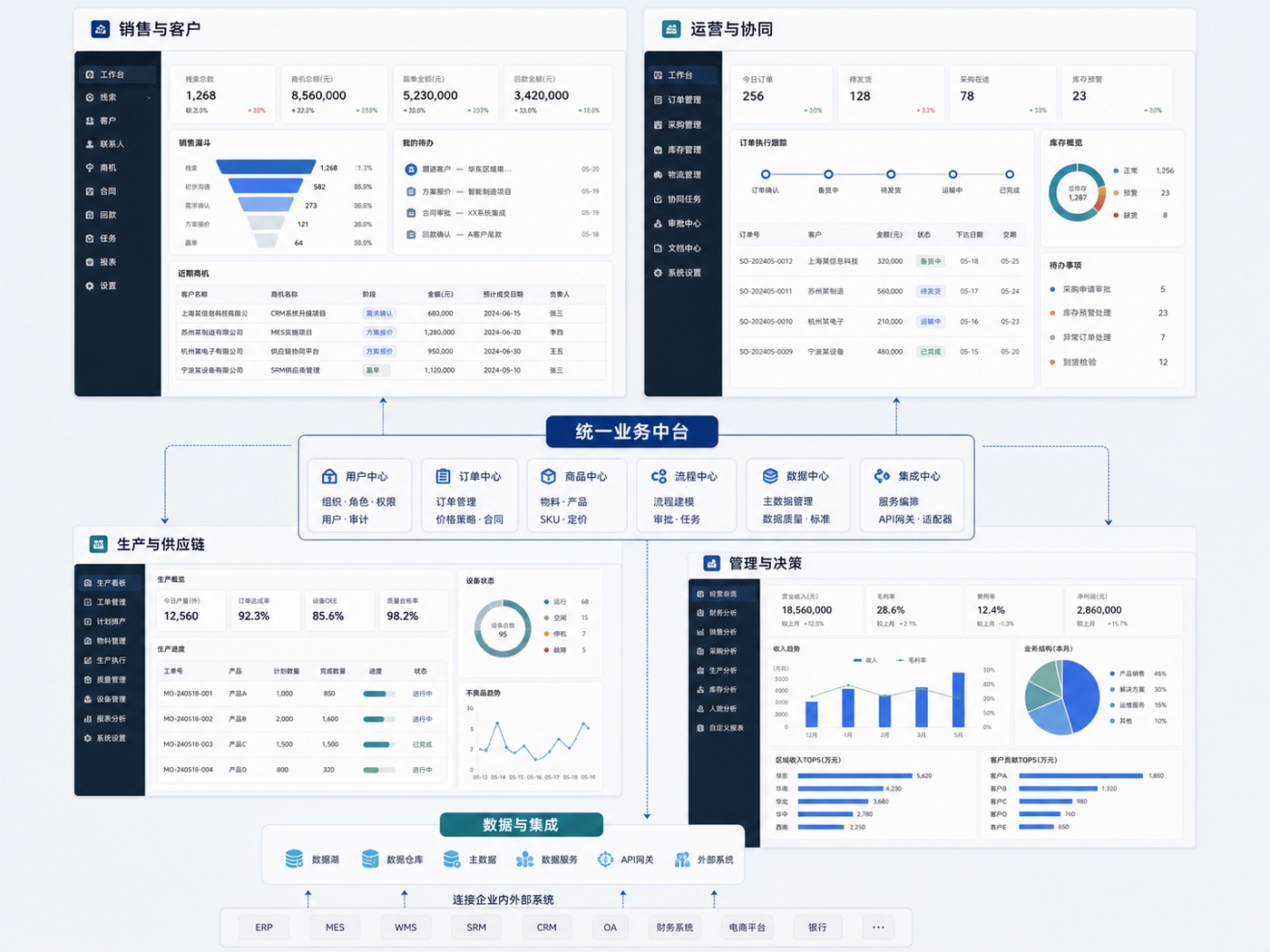
Sediment sharing capacity from key business links, which would obviate the need for new operations to build account numbers, commodities, orders, authority and data base over and over again.

Reduce duplication of constructionAccelerate business accessHarmonization of key dataSupport for incremental upgrading
Enterprise digital platform to connect sales operations production and decision-making systems
Direct findings

Principles for the implementation of enterprise digital platforms

Enterprise digitization platforms are not equivalent to one-time construction of “high- and medium-station stations”. It is more prudent to lock in high-capacity reuses such as orders, customers, commodities, organizations or settlements, and to identify which systems are still in charge, before gradually sinking platform capabilities through a unified interface, master data and processes.

FIT & BOUNDARY

Application of scenes and enforcement of boundaries

The question is first determined whether the issue is suitable for resolution through this programme, and then the scope of the construction and the pace of inputs.

Operational challenges

Systems are built separately, data and processes are difficult to communicate

Same capabilities are being developed over time and project delivery is becoming slower

The master data is not consistent, and management statements are difficult to harmonize

History system transformation is complicated and needs smooth evolution.

Programme capacity module

01

Harmonization of identity and organizational competencies

02

Shared centres for clients, commodities, orders, etc.

03

Process and Rule Configuration Platform

04

API gateway and integration capability

05

Data governance and business analysis

Proposed programme structure

The architecture level will be tailored to existing systems, data conditions and first-phase targets, with a focus on ensuring that business, data, integration and operational responsibilities are closed.

Business experience level

Maintaining the differentiated processes of client and employee orientation across business lines and not imposing the harmonization of all front-end experiences.

Shared operational capability level

Reusable capacity to settle customers, commodities, orders, organization, privileges and settlements by field.

Integration and process layer

Connect inventory systems and external platforms through API, news, tasking and unusual compensation.

Data and governance level

Defines the master data, the calibration of indicators, the authority, the rules of quality and the line of blood, supporting the analysis of operations.

Platform operating layer

Coverage of issuance, monitoring, auditing, capacity, security and service governance to ensure long-term viability.

Boundary of responsibilities and collaboration between the parties

ZhiHua Tech is responsible for status studies, boundary areas, general structure, platform development, integration migration and engineering delivery

Enterprise business owners confirm processes, rules, master data responsibility sectors and phase priorities

Inventory systems or third-party suppliers provide legal authorization, interface information, testing environment and coordination support

The parties jointly confirm the milestone range, the business demonstration script, the data reconciliation rules and the go-live window

Programme delivery results

SOLUTION OUTPUTPlatform planning and boundary description
SOLUTION OUTPUTApplication and data architecture
SOLUTION OUTPUTShared capacity services
SOLUTION OUTPUTInterface and Integrated Regulation
SOLUTION OUTPUTPlatform governance mechanism

Verifiable delivery evidence

(b) Retain reversible and accessible engineering materials at each stage, without oral representations in lieu of acceptance.

DELIVERY EVIDENCEOperational capability maps and system accountability matrix
DELIVERY EVIDENCEField model, data dictionary and interface account
DELIVERY EVIDENCEPrototype and scene presentation of key processes
DELIVERY EVIDENCEMigration reconciliation, inter-com tests and log-backs
DELIVERY EVIDENCERights matrix, surveillance alerts and manual on operationalization

Recommended acceptance and inspection baseline

01

The first core business process is able to be completely closed under the engagement role

02

Key master data and business documents are reconciled across systems by agreed calibre

03

Interface failed with logs, alarms, retests or manual compensation paths

04

Authority, audit, issuance and return programmes through joint exercises

05

Source code, configuration, account number, deployment and document completion to take over the handover

SCENARIO WALKTHROUGH

Implementation of the Business Digital Platform

A quantifiable capability scenario is used to describe how problems are defined, programmes designed and production acceptances completed.

Site Start

First, we'll deal with the one link that most affects business.

Assuming that the enterprise first encounters “system-building, which makes data and processes difficult to communicate.” The project team does not directly purchase tools, but selects the real tasks in the near future, recording monthly processing volumes, average waiting and processing times, a single completion rate, manual modification rates, unusual types and responsibility departments. The figures must be from systems records or manual samples that can be reviewed by the client; short-cycle accounts are created when information is insufficient, rather than for the creation of a fictional ROI.

How the indicative list should be designed

The following figures are used only to demonstrate measurement methods: if the original process handles 1,200 tasks per month, waits an average of 6 hours, actually processes 12 minutes, manual returns a rate of 15 per cent, the first target can be defined as “a 30 per cent reduction in waiting time, a 20 per cent reduction in manual processing time and a return rate not higher than the original baseline.” The receiving and inspection process provides both original samples, statistical queries and an unusual list. If the processing volume, business rules or sample difficulty changes significantly, the processing should be re-corrected and not just a good-performing date should be chosen to reach a conclusion.

The role privileges, historical data, external interfaces, capacity, security, backup and back-up checks should also be completed before official access. The first observation cycle after the line is run by the head of operations: check the real rate of adoption and then analyse the reasons for non-use, manual modification and mission failure. Only if the user continues to use and the quality floor does not decline will improvements in efficiency or performance indicators be of interpretive value.

DELIVERY PATH

From diagnosis to continuous operation

Each stage has clear objectives, participatory roles and assessable outcomes, and important decisions are not left to the end of the project.

01Operational capacity inventory
02Area and boundary design
03Core capacity-building
04Stock system access
05Ongoing governance operations
FAQ

FAQs

The most common issues before cooperation are clearly stated in advance.

Do all companies need to build a medium station?+

No. Platform building is more valuable when multiple operations repeat the same capabilities and the cost of system synergies continues to rise. Small-scale scenarios should be kept simple as a matter of priority.

Does the old system have to be completely rebuilt?+

Usually not recommended. There is a way to access progressively through interfaces, data and processes and to replace high-risk or high-cost modules with business values.

DECISION FAQ

Common issues related to current projects

Check out all 265 questions.
Corporate information selection, integration and data governance

How should data inconsistencies in multisystems be addressed?

The client, commodity, organization, inventory and order may be the primary responsibility of the different systems, with clear coding, calibration, synchronization and timing. Historical differences require an inventory, cleansing and manual validation, and no batch script can be used to conceal the root causes.

View full answer
Business Info, Systems integration and Transport

Which system should SMEs use first for informationization?

The process is used to prioritize mature products, requiring differentiated capabilities or complex integration before customisation is considered. The first target is to generate end-to-end closed loops and credible data, rather than to cover all sectors at a time. Management must designate the business leader and a single calibre.

View full answer
One-man company and OPC technical support

Does a company need a CRM, project management and knowledge base?

Whether or not information is complex is not the number of companies. When clients exceed memory control, the project has multiple nodes, and the programme needs to be reused, the corresponding system should be put in place; but the three capabilities need not be provided by three heavy platforms.

View full answer
One-man company and OPC technical support

How should data be integrated when dispersed using multiple AI tools?

First, identify the primary data system of clients, projects, contracts and knowledge, then position other AI tools as callers or processors, rather than keep a single primary record for each tool. Prioritize the use of official API, Webbook or regular export of synchronized fields, and harmonize customer and project identification. For unexportable closed tools, the risk of migration should be assessed and the critical business assets avoided.

View full answer