
Diagnostics and selection
Identification of processes, master data and system responsibilities(c) Combine the differences between key players, existing forms and systems, data calibres, interface conditions and enterprises that must be retained.
Enterprises that are suitable for customers, orders, procurement, inventory, production, projects, personnel, equipment and financial data, which are scattered in tables or multiple systems. First, judge which processes are used for mature products and which differential capabilities need to be customized or redeveloped, and then form sustainable business closed loops through master data, interfaces and migration.
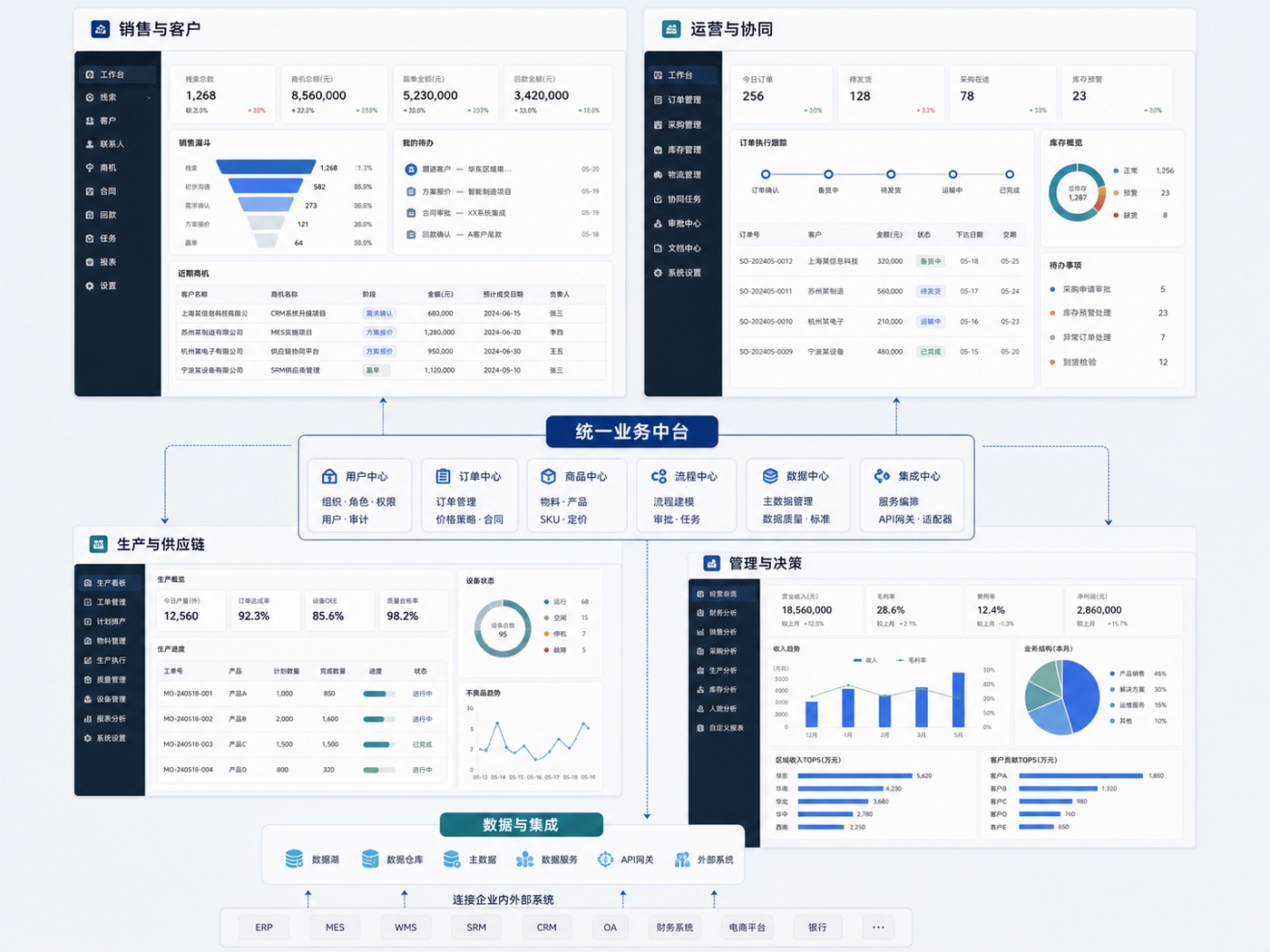
The common process prioritizes the assessment of mature products such as ERP, CRM, OA, WMS; differentiated channels, manufacturing, delivery or service capacity are re-configured, secondary development, peripheral customization and systemization.
The level of uncertainty is reduced by stages before deciding on the scale of inputs and the modalities of cooperation.
(c) Combine the differences between key players, existing forms and systems, data calibres, interface conditions and enterprises that must be retained.
Complete product configuration, necessary secondary development, master data governance, API interface, privileges and representative data migration.
Regular and unusual sample alignments are used to complete reconciliation, training, switching, retreat, monitoring and continuous optimization arrangements.
Standard product licences, implementation consultants, third-party interfaces, cloud resources and industry compliance costs need to be identified separately; the client is responsible for business rules, base data and internal change decisions, and ZhiHua Tech is contracted to undertake diagnostics, configuration development, integration migration, testing on-line and interface.
Purchased by system name, lack of end-to-end business and data planning
Repeated conflicts between customer, material, commodities, organization and project codes in different systems
Sales, orders, warehousing, production, delivery and finance remain hand-delivered
Secondary development lacks expansion and upgrade strategies, and updates often fail
Uplink acceptance only page, unverified migration, reconciliation, permissions and abnormal recovery
Survey of enterprise systems status, product selection, blueprint planning and variance analysis
ERP, CRM, OA/BPM, HRM and Project Synergy System Implementation and Customization
Supply chain and compliance systems building SCM, SSM, OMS, WMS, TMS
MES, APS, QMS, EAM/CMMS, PLM, systems integration
Finance, budget, fee control, funds, invoices, contract and payment system connections
Main data MDM, data platform, BI business analysis and cockpit management construction
API, information, single-point login, role privileges, approval, logbooks and monitoring
Historical data cleansing migration, piloting, batch switching, training and continuous transport
The service boundaries, budget bases and modalities of implementation for different phases of the project are not identical and can be further assessed in conjunction with the following.
The final delivery boundaries are defined according to the scope of services, the construction phase and the modalities of cooperation, and are described below as common results.
Service coverage and business closure required for the first phase: enterprise system status diagnosis, product selection, blueprint planning and variance analysis, ERP, CRM, OA/BPM, HRM and project synergy system implementation and customization
Level of integrity of existing codes, data, systems, equipment and documents, and scope of coverage to be audited, relocated or re-engineered
Number of third-party interfaces, coordination responsibilities, data quality, unusual compensation and external supplier cooperation
Non-functional requirements such as performance, availability, security, authority, audit, compliance and access windows
Delivery depth and long-term responsibility: interlocking, reconciliation, authority and acceptance records, deployment switch, retreat, operation and transport of the file, and quality assurance, transport of peacekeeping continuity ranges
Project objectives, responsible persons and acceptance criteria are not established
Key accounts, data, interfaces or business authorizations not available
Only the maximum price or very short cycle is sought, and the necessary tests and quality control are not accepted
The following are used to explain the implementation methodology, the data calibre and the boundaries of responsibility, and are not used as a proxy for project judgement by functional lists.
The project starts by selecting a business link that needs most improvement, interviewing the actual user and taking recent samples. The processing volume, average time-consuming, waiting time, back-work, unusual numbers and manual contact points around the "Classage of the enterprise system status, product selection, blueprint planning and variance analysis" is recorded; if the available data are incomplete, the baseline is used as a manual table account for one to two weeks in a row. Without a baseline, the project can only be completed by evaluating whether the interface is completed and it is not possible to judge whether the enterprise management and business system is bringing about sustainable business changes.
The baseline should also indicate the scope of the statistics and exclusions. For example, processing time begins with the availability of information or with the first submission by the client, the exception fails to include third-party interfaces, and manual modifications are minor proofreading or re-processing.
The first phase does not seek to cover all sectors, but rather forms a closed loop around “ERP, CRM, OA/BPM, HRM and Project Synergetic Systems” that can operate in real time: clearly defines the input, processing rules, system actions, responsible roles, abnormal movements and final output. Key roles include at least business owners, actual users, technical interfaces and receiving and inspection managers, avoiding demand being described by management and being used on the online front by another group.
The need assessment corresponds each competency to the business scene, user role and sample acceptance. Matters that do not provide legitimate data, interfaces or decision makers should be included as a pre-condition or subsequent stage, and should not be included quietly in a fixed-range offer.
A typical path is the business diagnostic and status inventory, product selection and variance analysis, prototype configuration and interface design, secondary development and data preparation. Each stage should result in identifiable outcomes, such as flow charts, prototypes, interface compacts, test records, deployment descriptions or running demonstrations. In the development process, changes in requirements, deficiencies, risk and decision-making records are maintained; when data migration, external interfaces or AI outputs are involved, failure retrying, manual takeover and back-off programmes are also designed.
The stage demonstration is not “looks fit to work”. A representative sample should be used to cover normal processes, missing fields, repeat requests, inadequate authority, time overruns and historical data anomalies from external services, and to identify problems that arise only in the production environment at an early stage.
The project should at least reconcile the business process and system responsibility blueprint, product selection and variance analysis, configuration checklist, secondary development source code and interface services, and confirm source or configuration attribution, account management, build deployment, data backup, failure response and subsequent maintenance responsibilities. In addition to functional acceptance, check access, security, performance, logs, recoverability and key user training to ensure that client teams are able to use and understand the system boundaries independently.
Assuming a process baseline of 800 items per month, an average of 18 minutes per unit, and a return rate of 12 per cent, this is only an example, not a client's performance. Upline should be followed by continuous observation of the same calibre for four to eight weeks, before judging whether the client, order, supply, production and refund process can be tracked, data from across the system reduced duplication and manual transmission, and a reasonable division of labour between standard products and differential operations.
This page contains organizational content around real service issues such as enterprise management system development, enterprise business system customization, project management system, contract management system. Keywords are used to help users and search system identify themes, not to represent commitments to fixed effects; final scope, cycle, budget and indicators are based on project diagnostics, contracts and acceptance baselines.
Each stage has clear objectives, participatory roles and assessable outcomes, and important decisions are not left to the end of the project.
The most common issues before cooperation are clearly stated in advance.
Common processes such as finance, procurement and inventory usually prioritize the assessment of mature products; business differentiation in sales, channels, services or production capacity can be integrated with secondary development, peripheral systems and interfaces, avoiding placing all rules at the ERP core.
Yes. First, it is necessary to determine which system is responsible for the customer, commodity, order and refund, and then to design the field map, the single key, the synchronized direction, the repeat request and the failure compensation.
Not necessarily. The main data, unfinished business, recent history and archived data should be distinguished from the needs of queries, audits and operations, and the migration results should be validated through sampling and volume reconciliations.
The licences, configurations, secondary development codes, databases, interfaces, account numbers and implementation files can be taken first, and then the diagnosis will determine whether to continue repair, re-implement or phase-in.
Systems such as OA/BPM, HRM, SCM/SRM, OMS/WMS/TMS, MES/QMS/EAM, PLM, FC, Master Data and BI can be planned and implemented according to business needs, and can also be accessed and redeveloped.
Not necessarily. Processes prioritize mature products and industry options when they are more standard; and select configuration, plugin, peripheral customization or development when special processes, equipment, warehousing strategies or cross-system processes are present.
The system name is only an entry point and formal programmes still need to be identified in the context of industry processes, existing products, data base and first-period business objectives.
Management trails, customers, business opportunities, offers, contracts, membership, after-sales services and clients throughout their life cycle.
(c) Carrying out organizational, personnel, approval, synergy, project delivery, contracts and internal knowledge processes.
Connect suppliers, procurement, orders, inventory, warehousing, transportation and delivery status.
Covers production implementation, planned scheduling, quality, equipment assets, maintenance and site data.
Manage product structures, drawing documents, research and development processes, changes in versions and technical information.
Connect business documents, costs, budgets, payments, billing, accounting, funds and operating results.
Harmonization of master data, indicator calibres, business analysis, early warning and cross-system data services.
Business platforms around door shops, hotels, retail, electricians and professional services are developed to operate sustainably.
Specific product licences, original plant services, industry certification and third-party fees are recognized separately by project.
Common processes such as finance, procurement, inventory, etc. should normally prioritize the assessment of mature ERPs, not all of which are not agreed to from zero. The unique business rules of the enterprise, external platforms, and on-site equipment may need to be expanded or independently customized. The choice is not between “standards or customizations”, but rather, to identify which processes accept standardization and which capabilities constitute competitive advantages. Process and differences analysis is first followed by the determination of product configuration, secondary development and peripheral custom borders.
View full answerBusiness Info, Systems integration and TransportMost systems can be integrated through API, news, timing or controlled file exchanges, but first by confirming interface capacity and data responsibility. Each core type of data should have a single primary responsibility system, and other systems should read or write back as agreed. Important links also need to be addressed, for example, through retesting, compensation, logs and manual reconciliation. The system is connected only as a first step, and long-term consistency and unusual operations are more important.
View full answerCorporate information selection, integration and data governanceThe client, commodity, organization, inventory and order may be the primary responsibility of the different systems, with clear coding, calibration, synchronization and timing. Historical differences require an inventory, cleansing and manual validation, and no batch script can be used to conceal the root causes.
View full answerEnterprise operations and operations management systemThe main line of contract and project should be the harmonization of the relationship between the client, contract, project, milestone, cost target, invoice and refund. The scope of operations system management, delivery and settlement processes, and the financial system should maintain formal accounting and supporting documentation.
View full answerFull budget from software, configuration, secondary, interface, migration, training and transport understanding
For more information.Organizational synergyBuilding approval, portal, project synergy and cross-system workflow
For more information.Production implementationConnecting worksheets, reporters, quality, traceability and site equipment
For more information.Warehousing performanceManagement of order, inventory, warehousing, transport and logistics
For more information.Supply chain procurementManagement of vendors, sourcing, procurement, delivery, quality and performance
For more information.Development of quality equipmentConnect product versions, quality closed loops and maintenance of equipment assets
For more information.