Home / Services / Enterprise AI passenger service development, intelligent passenger service system implementation and operation
PROFESSIONAL SERVICE

AI Customer Service Development

Instead of making AI client service a chatty robot, it begins with a genuine advisory classification, linking business knowledge and enabling business systems, allowing standard issues to be automatically handled, complex issues to be easily manipulated and quality control through continuous evaluation.

Standard advice received faster responseArtificial seating focused on complex and high-value issuesResponse basis, system query and transfer process traceableContinuous updating mechanism for client knowledge formationContinuous improvement in the quality of services through real data
Query business Query manual collaboration and operational evaluation of the enterprise AI client service

Problems that enterprises usually face

Common models are not aware of business policies, products and real-time business data

Knowledge versions conflict or expire, with responses lacking evidence and responsible persons

High-risk issues such as complaints, refund disputes could not be identified and timely transfers made

The client service system, CRM, orders and membership data are fragmented

Only automatic response numbers, lack of quality and operational effectiveness assessments

Our core services

01

Historical advisory analysis, problem classification, risk classification and automated opportunity assessment

02

Client knowledge cleansing, RAG retrieval, source references and version governance

03

Authorized business queries such as orders, membership, logistics, door stores and worksheets

04

Multi-cycle sessions, context management, hand-seat transfer and summary of sessions

05

Sensitive issues identification, filtering of authority, operational audit and manual confirmation

06

Real set of questions, quality of answers, conversion rate and satisfaction assessment

07

Manage backstage, knowledge updates, bad case and ongoing operations

PROJECT DECISION PATH

Continue to judge in the context of current projects

The service boundaries, budget bases and modalities of implementation for different phases of the project are not identical and can be further assessed in conjunction with the following.

Project deliverables

The final delivery boundaries are defined according to the scope of services, the construction phase and the modalities of cooperation, and are described below as common results.

DELIVERABLEService scene analysis and risk classification report
DELIVERABLEData governance and updating of norms
DELIVERABLEAI client service application, administration backstage and system interface
DELIVERABLEManual collaboration, authority and operational audit programme
DELIVERABLEAssessment of real problems, testing and reporting online
DELIVERABLEManual for the deployment, training and continuous optimization of peacekeeping

How the project budget is assessed

Scope of services and business closed loops that must be completed in the first phase: historical advisory analysis, problem classification, risk classification and automated opportunity assessment, customer knowledge cleansing, RG retrieval, source citation and version governance

Level of integrity of existing codes, data, systems, equipment and documents, and scope of coverage to be audited, relocated or re-engineered

Number of third-party interfaces, coordination responsibilities, data quality, unusual compensation and external supplier cooperation

Non-functional requirements such as performance, availability, security, authority, audit, compliance and access windows

Delivery depth and long-term responsibility: real-issue assessment, testing and reporting, deployment, training, handbook on peacekeeping optimization and quality assurance, peacekeeping continuity and iterative scope

These circumstances do not recommend immediate initiation of full development.

Project objectives, responsible persons and acceptance criteria are not established

Key accounts, data, interfaces or business authorizations not available

Only the maximum price or very short cycle is sought, and the necessary tests and quality control are not accepted

IMPLEMENTATION PLAYBOOK

How to move from demand to acceptance results for the development and implementation of AI client services

The following are used to explain the implementation methodology, the data calibre and the boundaries of responsibility, and are not used as a proxy for project judgement by functional lists.

Keywords and description of content

This page contains organizational content around real service issues such as AI client development, AI passenger service system, smart passenger service system development, AI customer service implementation. Keywords are used to help users and search system identify themes, without implying commitment to fixed effects; final scope, cycle, budget and indicators are based on project diagnosis, contract and acceptance baseline.

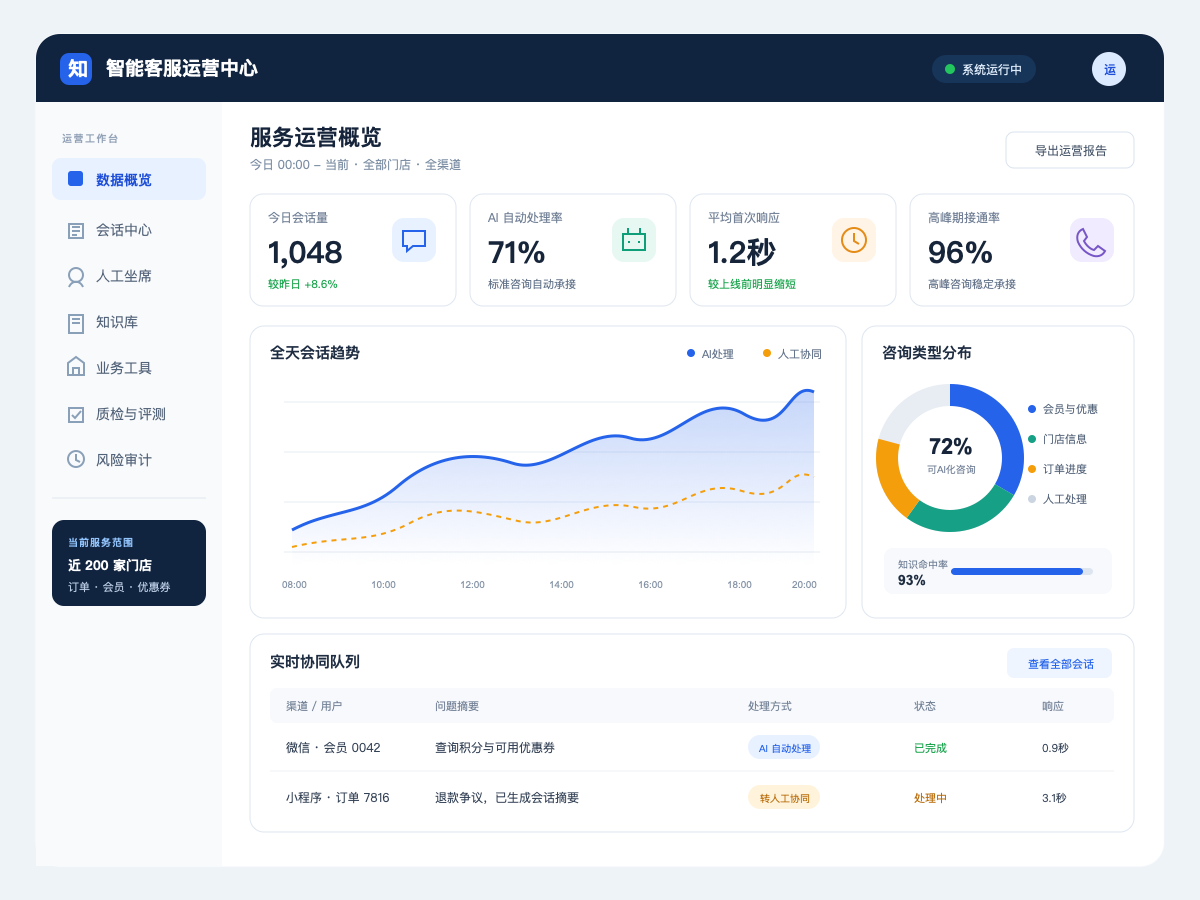
DELIVERY PATH

Implementation and delivery pathways

Each stage has clear objectives, participatory roles and assessable outcomes, and important decisions are not left to the end of the project.

01Consultation data analysis and scenario classification
02Knowledge and system interface preparation
03Prototype and real question assessment
04Application of passenger uniforms and manual teamwork
05Security test and greyscale on line
06Re-entry and continuous optimization
FAQ

FAQs

The most common issues before cooperation are clearly stated in advance.

Will the AI client service be a complete substitute for the artificial passenger service?+

Usually no recommendation. The rules are clear and less risky. Issues that are appropriate for AI; complaints, refund disputes, sensitive commitments and situations requiring a common sense of judgement should be passed on manually and the reasons for the transfer and context should be communicated.

Can AI client service search for orders and membership information?+

The authorization interface can be called within the user identification, minimum privileges and audit boundaries.

How's the enterprise AI service going?+

It is recommended that the true set of questions be used to check the basis of the answer, the validity of the business queries, the rules for refusal and conversion, the segregation of competencies, the response time and the manual takeover, and that a record of the assessment be maintained that can be repeated.

Can we start without the knowledge case?+

While the inventory of client service information and historical advice can be taken first, the knowledge cleansing, version recognition and responsible person mechanism should be used as a necessary pre-official entry rather than simply handing over all documents to the model.

DECISION FAQ

Common issues related to current projects

Check out all 265 questions.
%1 %1

Is it true that AI's service is a substitute for artificial service?

AI client service is more suitable for high frequency, clear rules and well-informed questions, and does not recommend a complete replacement for labour. Complaints, refund disputes, sensitive commitments and complex judgements should be transferred to authorized seats. A good system transfers user context, citing sources and executed actions, rather than allowing customers to repeat them.

View full answer
AI System Transport, VoiceAgent and Visual Recognition

What business is it appropriate to use AA voice-based guest or voice-based Agent?

The first validation is best served by high frequency, process stability, clear answers or operational boundaries, and quick manual transfers. Common scenarios include consulting diversions, booking confirmation, progress queries, service announcements, standard return visits and seating aids. Complex complaints, price negotiations, professional diagnostics and high-risk commitments are not directly automatic.

View full answer
AI System Transport, VoiceAgent and Visual Recognition

How does the AI voice service design a switchman and seating collaboration?

The transfer should not occur only after the user has spoken a fixed keyword, but should be triggered by a combination of low confidence, repeated failure, sensitive intent, emotional escalation and high-risk business rules. The transfer requires the presence of identity, a summary of the call, confirmed information and reasons for failure. The robot cannot continue to engage in conflict operations after manual takeover. The transfer of data should also be informed, verbally and process improvements, rather than counting the number of calls.

View full answer
%1 %1

Which business scenarios does AI Agent fit?

AI Agent is fit for mission that is well targeted, tool interfaces are manageable, process is documented and failure can be manually taken over. Common scenarios include information retrieval, document processing, worksheet classification, sales preparation, operational reporting and cross-system information collation. High-risk actions such as payments, formal offers, public releases and key data modifications should be retained for authorization approval.

View full answer