
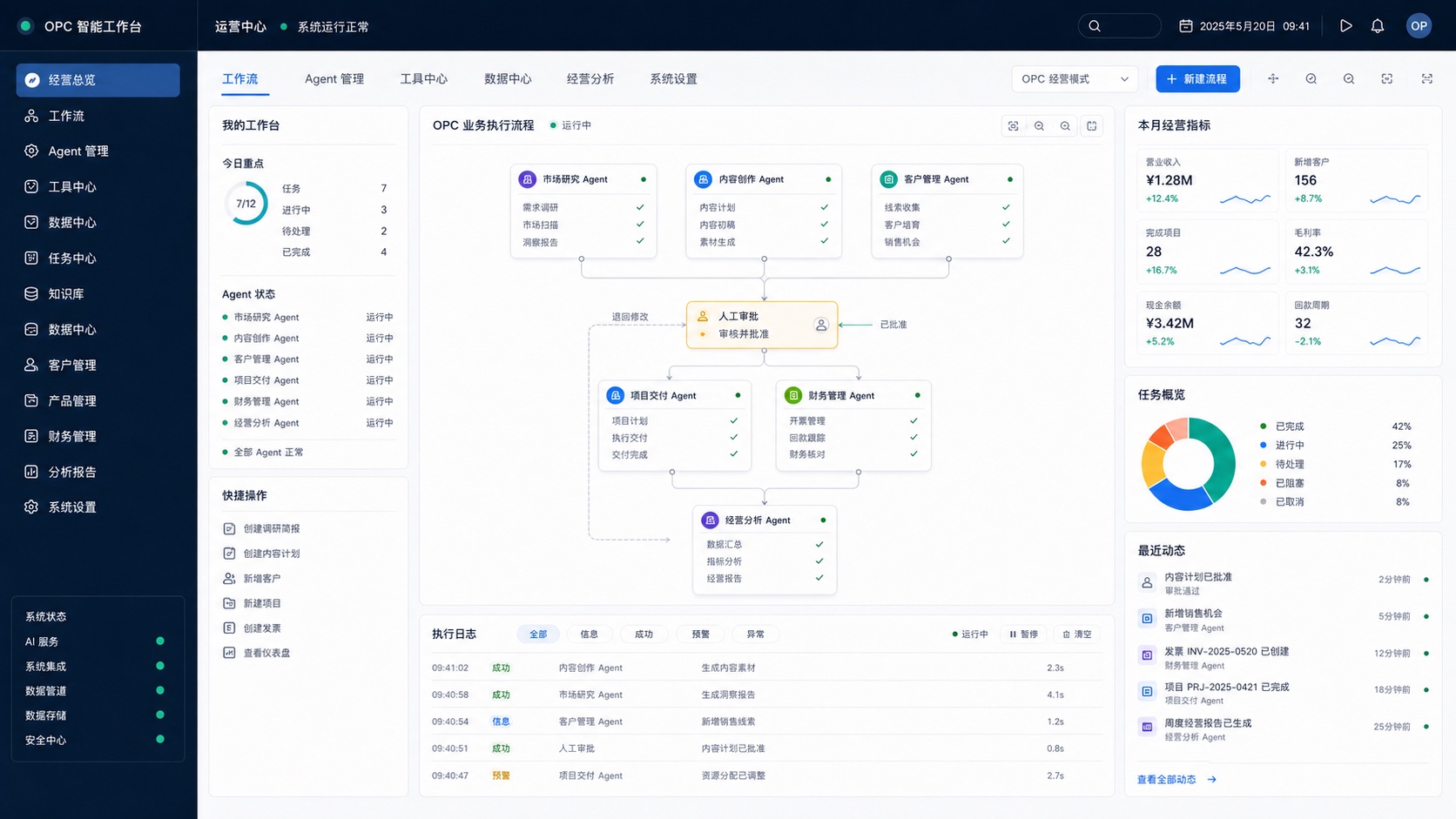
Principle 1: Establish a minimum business closed circle before creating the Agent team
The OPC should first identify the target clients, core issues, standard products, how to get to the customers, the trade routes, the delivery results, and the repurchase mechanisms. When business is closed, multiple Agent only accelerates content noise and tool costs.
It is recommended that a core service be selected that can be independently traded and delivered, and that the process of detection from client to payback be channelled, identifying the tasks that are duplicated, time-consuming and rule-based. Agent should be built around business roles, not around popular tools.
- Market Research Agent: Tracking Client Problems and Industry Changes
- Content Agent: Production of multiple channels of content based on brand knowledge
- Sales Agent: Collating leads, preparing programs and alert follow-up
- Delivery of Agent: mission, materials and acceptance by template
- Operation of Agent: Summary of income, cost, time and transformation data
Every Agent needs a job description.
The more clearly the job boundaries are, the easier to assess and replace.
For example, content Agent could prepare drafts, check brand tone and split channel versions, but could not be published without personal confirmation; sales of Agent could generate communication advice based on customer information, but could not commit to price, periodicity and contractual terms on its own.
Connecting Agent with the workflow instead of letting them talk freely.
MultiAgent collaboration requires clarity about mission status and the interface. For example, research into the insight of the sources of the Agent output belt, the content of which is based on insight to form the selection, the validation of the node is confirmed by the person, and the data is released and then returned to the business analysis.
The tool layer can connect to the mailbox, calendar, form, document, CRM and project systems through API, automated platform or MCP; collaborative agreements such as A2A are evaluated when there is a need to cross Agent. Small-scale scenarios are often more reliable than complex self-government networks.
- Harmonize task ID and client ID to avoid information threads
- Identify who created the mission, who carried it out, who approved it
- Failed tasks enter manual queues, and no limit to automatic retry
- Auto-execut by default for high-risk actions
Personal knowledge base is long-term compound asset
The OPC should continuously sink product descriptions, client issues, case methodology, quotation boundaries, delivery templates, content styles and double-entry records.
The client's exclusive information is separated from public knowledge and the contract, account number and privacy information are not directly placed in the general context.
Managing quality, cost and operating risks at the same time
The time saved by each process, the percentage of manual modifications, the thread conversion, the quality of delivery, models and subscription costs should be recorded.
The tool is only authorized to be issued publicly, the customer's commitment, the offer contract, the refund of payment, the deletion of data and accounts. The tool is only authorized to perform the minimum required tasks, the voucher is stored securely and the expired connection and the authorization is checked regularly for permanent absence.
A set of 30-day implementable construction sequences
The first week of combing the business closed loop and time consumption; the second week of creating knowledge base, templates and mission status; the third week of automating a low-risk high frequency process; the fourth week of running and rediscovering a real client mission. Only after the first closed circle has stabilized will the second Agent be expanded.
ZhiHua Tech can provide an OPC capability diagnostic, tool selection, knowledge case, Agent design, automated integration, deployment training, and ongoing support based on the current state of the individual’s business. The goal is not to create complex systems, but to allow operators to focus their time on positioning, relationships, products, and key decision-making.
- Week 1: Business processes and time audits
- Week 2: Knowledge, templates and data structure
- Week 3: A person who has a full workflow with an Agent
- Week 4: Real running, quality assessment and input output double
Turned OPC One Company from reading findings to project input
The most likely problem after reading methodological articles is the acceptance of principles, which are not translated into the next step. It is proposed that the head of operations organize a 60-90-minute mini-workshop, choosing only one real process and not rushing to discuss the full platform.
Step 1: Establishment of a current status and sample baseline
Around “Principle One: Establish a minimum business closure, then create an Agent team” to extract recent normal, unusual and border tasks, recording monthly processing, waiting times, actual processing time, back-to-work, manual contact, error consequences and current tools. If data are insufficient, it is possible to record a period of one to two weeks, but with a reference to the sample cycle and business fluctuations. Do not set a good rate of savings and then reverse the data.
Step 2: Clarifying the initial closure and inaction
The first phase is designed to allow a chain to run and be retraceable, rather than to add multiple Agent systems, AI Agent workflows, one-person ACAI to the same version.
Step 3: Match technical results to engineering evidence
A tracking relationship between demand numbers, sample numbers, test results and versions is built around “workstream connections, rather than free chats”. OPC has limited resources and should record the actual time saved by the operator, manual review rates, tool subscriptions and model calls.
Step 4: Receiving, inspection and disking with the same calibre
Assuming that the original process handles 600 tasks per month, an average of 20 minutes and a return rate of 10 per cent, the target can be described as “six weeks after the start-up, with an average reduction of 25 per cent in time, and a return rate of not more than the original baseline, given the close complexity of the task.” This set only demonstrates the measurement method and does not represent any client's results; the official indicators must be identified by the enterprise on the basis of its own sample.
- Operational material: flowchart, role, sample mission, current issues and baseline data
- Technical material: system inventory, interface, data access, deployment environment and security requirements
- Project material: first-phase scope, exclusions, liability matrix, milestones and change mechanisms
- Receiving and inspection material: test set, execution records, list of deficiencies, indicator queries and handover documents
When these materials are identified jointly by both the operational and technical parties, the method in the article is actually entered into the project. If key data, interface authorization or the responsible person are not in place, the logical next step is usually a limited diagnostic or PoC, rather than an immediate commitment to complete the work period and fixed total price.
Official reference
- State Council opinion on the further implementation of the "Advisory Intelligence Plus" initiativeState Council
- Model Context Protocol:Architecture OverviewMCP Official Document.
- A2A Protocol: Agent Collaboration and Interoperability NoteA2A Project · 2026
Implement methodology to project action
- Opc will verify the minimum business closed loop and increase the number of Agents.
- Every agent must have a job boundary, a tool's license and quality.
- Manage multi-Agent collaboration with clear workflow and manual clearance
- Continued automation with time, quality, transformation and cost
Continuing to reconcile common issues in project decision-making
What is the normal content of technical support by an OPC company?
The first phase should be built around a true closed circle in the recipient, sale, delivery or operation, rather than a large build-up of AI tools. The tool is to be consistent with the individual's time, budget and maintenance capabilities. The ultimate goal is to reduce duplication of effort while retaining manual control over client commitment and key decision-making.
View full answerOne-man company and OPC technical supportCan AI Agent follow up on clients, quotations and dispatch contracts automatically?
AI Agent can organize leads, alert follow-up, generate drafts of quotations, fill out contract variables and prepare for delivery without recommending a price, scope or legal provision for external commitments without artificial confirmation.
View full answerOne-man company and OPC technical supportHow should data be integrated when dispersed using multiple AI tools?
First, identify the primary data system of clients, projects, contracts and knowledge, then position other AI tools as callers or processors, rather than keep a single primary record for each tool. Prioritize the use of official API, Webbook or regular export of synchronized fields, and harmonize customer and project identification. For unexportable closed tools, the risk of migration should be assessed and the critical business assets avoided.
View full answerEnterprise AI Transport Organization and ImplementationDo small and medium-sized Enterprises AI Transformation need a full-time AI team?
The first phase does not necessarily require a full-time AI team, but it must have an in-house business manager and technical interface.
View full answerNeed to build up an OPC capability for yourself?
We provide OPC capability diagnostics, AI tool selection, professional Agent, automated integration, deployment training and ongoing technical support.