
What is the usual content of OPC technology support?
It is not appropriate to enter the full project directly without the real task and responsibility.
For individual companies, one company, super-individuals and individual entrepreneurs, the system introduces individual company technical support, OPC business design, AI tool selection, Agent workflow, knowledge case, automated integration and safe operation methods.
The topic is not a collection of articles, but a decision-making path from problem identification, programme selection and project acceptance.
It is not appropriate to enter the full project directly without the real task and responsibility.
The ICP is harmonized in terms of scope, data, interfaces, privileges, quality and transport. Each conclusion is required to describe assumptions and exclusions and to avoid comparing only the number of functions or a total price without a boundary.
Select a representative sample to validate normal, unusual and boundary tasks, while recording quality, processing time, manual intervention, running costs and consequences, creating a repetitivable basis for decision-making.
The up-line acceptance and inspection should reconcile delivery, engineering evidence and operational indicators, and clarify account numbers, data, source code, configuration, documentation, training and subsequent operational responsibilities, enabling the enterprise to maintain its capacity to use and take over.
The first reading allows for entry into the articles closest to the current problem, and the compilation of terms, risks and candidate paths; the preparation of items is followed by a review of the corresponding service pages, solutions and competency cases, bringing in the volume of business, sample, existing systems, budget levels and planning time.
The sample data that appear on the theme page are used to explain the method and do not represent the results of a particular client. The enterprise should establish its own baseline before the project begins and agree on the statistical scope, data sources and observation cycle.
From business judgement, methodological design to project delivery, a complete understanding of the problem is gradually being developed.
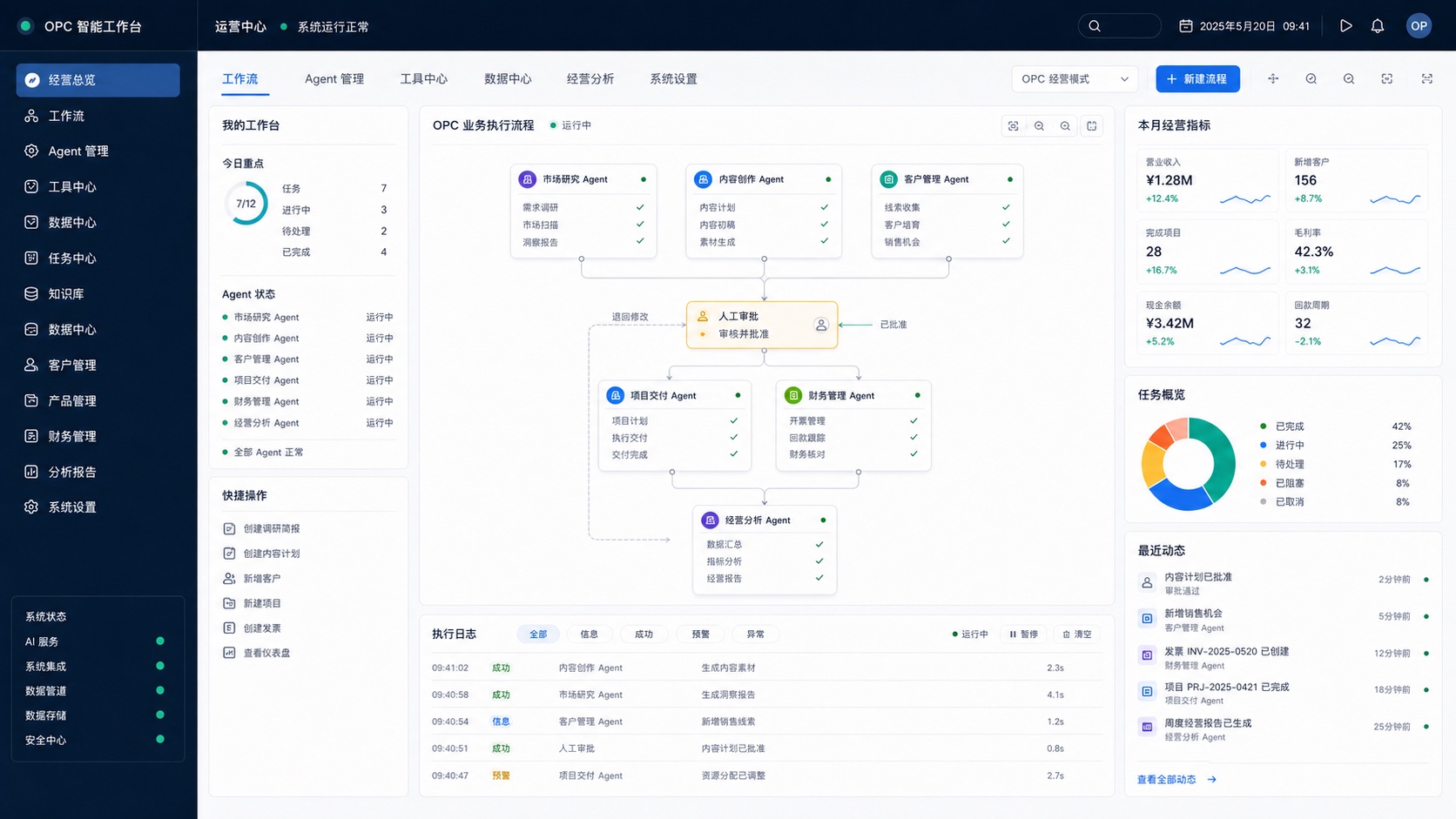
For one company, individual company and super-individual, how technical support connects content of the network, customer trails, offer contracts, project delivery, knowledge base, AI Agent and automated workflow.
For individual companies, one company, super-individual and small-scale entrepreneurial teams, the system describes how individual company technical support covers websites, customer management, knowledge base, AI Agent, workflow automation, interface integration, data security and ongoing maintenance.
Description of the range of services supported by OPC, showing how a company combs the closed loop, selects the AI tool, builds knowledge base with professional Agent, connects automated workflows, and controls privileges, quality and costs.
One company, OPC, should maintain control around the acquisition, sale, delivery, customer service and business analysis design specializations of Agent, knowledge base and automated workflows, and maintain control over manual clearance, cost and quality indicators.
One company, OPC, can organize the market, content, customer and delivery into a sustainable personal business system through business focus, task standardization, AI tool chains, professional Agent and human machine clearance mechanisms.
For one company and super individuals, describe the business diagnostics, tool selection, knowledge base, AI Agent, workflow, systems integration, security governance, cost and acceptance methods covered by OPC technical support.
Continued examination of the structure, delivery and implementation experience relevant to the topic.
Create complete pathways from minimum tool combinations, Agent, automating connections to individual company-owned systems
For more information.Individual corporate guidelinesSet an enforceable route from tool inventory, customer knowledge, Agent, automation to cost security
For more information.Capability sceneSee how clues, customers, projects, knowledge, Agent and business resets form the closed loop
For more information.OPC service detailKnow business diagnostics, tools, knowledge base, Agent, workflow, cost and acceptance methods
For more information.Capability sceneView the deliverables of clients, knowledge, Agent, workflow, authority and cost management
For more information.Agent Workstation PracticeOrganizing knowledge, tasks, tools and clearances into digital workstations that can be managed by an operator
For more information.A company does not need to purchase complete enterprise software from the outset, but first establishes six basic types of customer trails, project assignments, documentation knowledge, contract collection, account security, and data backup. Each type prioritizes a primary tool that runs the shortest process from the time of the receipt to the time of delivery, and adds automation and AIAgent based on duplication of effort. The more efficient the tool, the more important is whether it can produce a unified record and stabilize the process.
View full answerFDE, OPC and AI Project DeliveryThe first phase should be built around a true closed circle in the recipient, sale, delivery or operation, rather than a large build-up of AI tools. The tool is to be consistent with the individual's time, budget and maintenance capabilities. The ultimate goal is to reduce duplication of effort while retaining manual control over client commitment and key decision-making.
View full answer%1 %1Simple tasks PoC can be done faster, but production on line requires data, tool interfaces, privileges, assessments, logs and manual takeover. The cycle depends mainly on business rules and system preparation, not model calls. It is recommended that a single task be validated in two to four weeks, followed by a systems implementation and small-scale testing in stages. Without a fixed sample and acceptance standard, even if demonstrated quickly, it is impossible to judge when it will be available.
View full answerEnterprise AI Transport Organization and ImplementationEnvironmental AI Transport requires operational and IT co-responsibility, but with different responsibilities. Business sector definition issues, knowledge calibre, real samples and end results, and IT or technical teams are responsible for data interfaces, identity privileges, architecture, security, dissemination and transport. Management is responsible for setting priorities, budgeting and cross-sectoral decision-making.
View full answerThe thematic content is used to understand problems, professional services and solutions to develop enforceable pathways that combine the current state of the enterprise.
OPC technical support for one company, super-individual and small-scale business teams, one-person AI tool and Agent implementation, covering process diagnosis, tool selection, knowledge case, automated integration, training and continuous operation.
For more information.Professional servicesProvides FDE outsourcing, field-based AI engineers and Forward Depoyed Engineers to conduct in-depth operations to advance in-house operations, enterprise AIP, AI Agent, RAGnowledge base, systems integration, evaluation and online operations.
For more information.SolutionsBuilding a market-based research, content production, customer management, project delivery, knowledge base and business analysis for one company and super-individuals, and AI tools and Agent collaborative work desk.
For more information.SolutionsThe implementation of the software, which is implemented through the FDE outsourcing to the enterprise ' s business site, is advanced by the implementation of the small and medium-sized Enterprise AI Transport, AI Action and AI software, covering scene diagnostics, RAGnowledge base, systems integration, evaluation, competency governance and online operations.
For more information.