
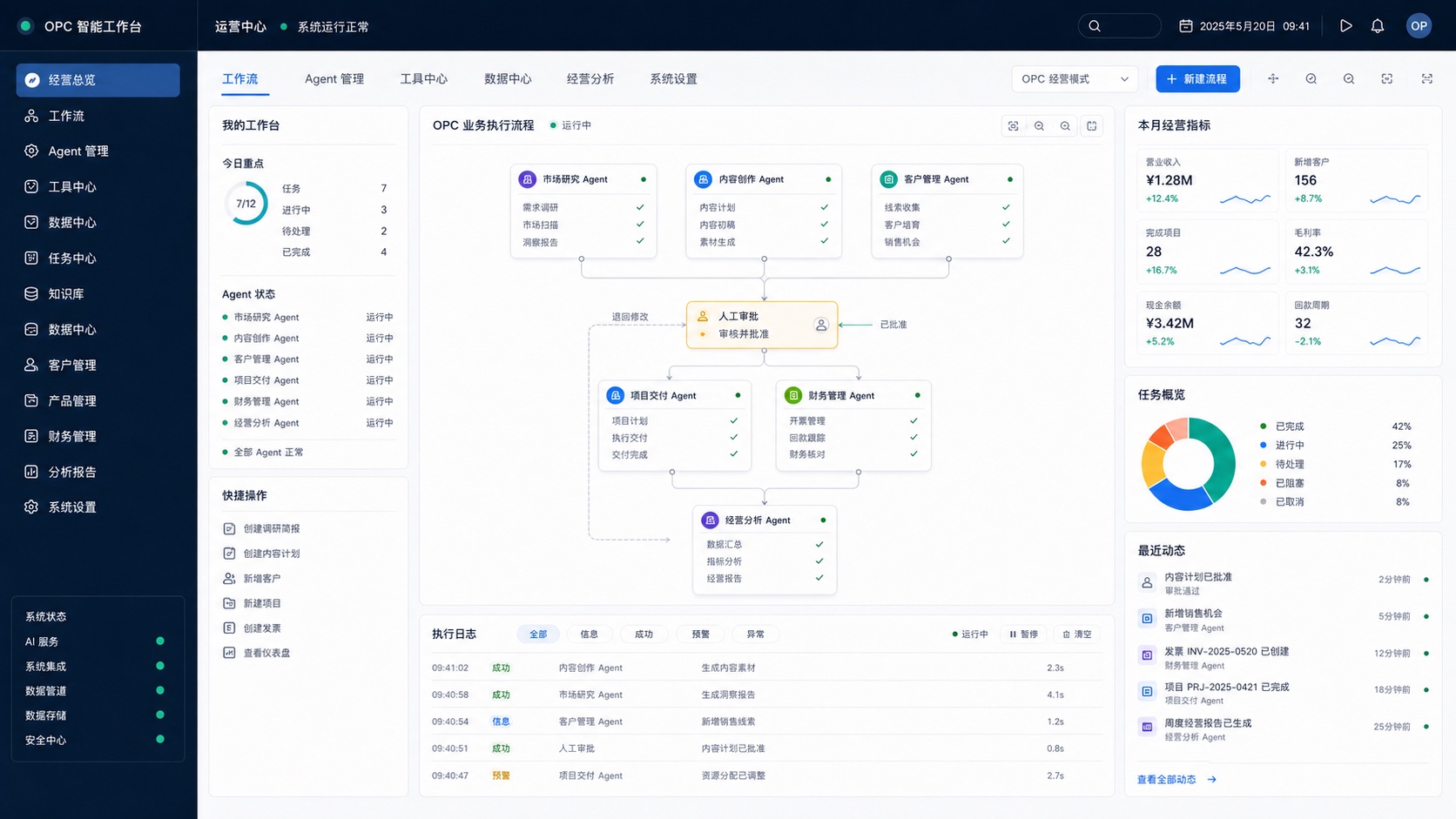
Design technical support starting with a real client journey.
Select a typical client, drawing the full path from the sighting of content, initiation of counselling, demand communication, proposal offer, contract execution, project delivery to the return of a refund.
The problem for a company is often not a lack of a certain function, but a spread of information in micro-mails, mailboxes, forms and multiple SaaS. Technical support should first establish links between clients, projects, tasks and knowledge, so that operators can always know what the customer is at, what the next step is, and what commitments must be confirmed.
- Recipients: Unified collection of official networks, content, activities and recommendations
- Deal: Communication summary, demand, programme, quotation and contract version linkages
- Delivery: Mandate, information, acceptance, issues and change centralized management
- Operations: Refunds, costs, sources of leads and retrofits available
Configure the smallest mix of tools before deciding whether to develop a proprietary system
The initial combination of the official network, business mailboxes, online forms, calendars, documents, client desk accounts and project tools can be used. The selection of tools focuses on checking data exportability, API availability, clarity of privileges, availability of mobile end-ends, and retention of critical information after the subscription has been stopped.
When the same information requires double-entry across tools, long-term stability of standard processes, business data need to be centrally statistical, or where the existing tools limit client experience, one-person company-specific systems are considered. The exclusive system does not necessarily develop all functionality from zero, allowing for the retention of mature SaaS, which is connected through API, automated platform or light business backstage.
Let AI Agent take the lead, not make a key commitment for the operator.
A company, AI Agent, is suitable for information retrieval, conference-processing, client background studies, preliminary programme, delivery inspection, mission alerts and business aggregation.
Each Agent needs to clearly enter, allow access to knowledge, tools that can be accessed, output formats, prohibitions and manual takeover conditions. Instead of creating an unlimited “Agent”, it should be detached from responsibilities for research, content, sales preparation, project delivery and operation, and complete implementation of the log.
- Study Agent to organize client, industry and demand background
- Content Agent prepares articles or video scripts based on knowledge and case studies
- Sale of Agent to form a communication summary, a list of needs and draft programmes
- Delivery of Agent to check information, tasks, changes and acceptance status
- Operation of Agent ' s summary trail, projects, revenues, costs and risks
Connecting threads, clients and projects through automated workflows
Automation of workflows is appropriate for handling relatively stable actions of the rules. Examples are customer records created after the website has submitted its advice, reminders to operators for confirmation, the first communication list generated; summaries kept after meetings and follow-up missions created; and information and acceptances checked by template after the project has entered the delivery phase.
The value of technical support is not to leave all actions uninvolved, but to automatically complete the preparation of duplicates, leaving the operator’s attention to judgement, relationships and professional delivery.
Control of client data, account numbers and model call risk
The small size of the individual company does not mean that security can be ignored.
Before sending customer information to the AI model, you should confirm the contract, privacy and service provider rules. Sensitive information can be dissensitized and key customers or projects managed in an independent knowledge space.
Establishment of a single-person company technical capacity in three phases
The first phase involves one to two weeks of completion of the process inventory, account governance and client project desk; the second phase selects a high frequency closed loop, with knowledge, Agent and automation and authentic mission validation; and the third phase observes four to eight weeks of usage before deciding whether to develop a separate back-office, connect more systems or add new Agent.
The receipt and inspection record missing threads, the first response time, the time of preparation of the programme, the rate of complete delivery, the percentage of manual modifications and the cost of the tool. For example, 5 of 20 consultations per month require a double background, and if the automatic aggregation is only confirmed by the operator, the time saved can be used directly for high-value communication.
Automation of a person's business to a project entry from reading findings
The most likely problem after reading methodological articles is the acceptance of principles, which are not translated into the next step. It is proposed that the head of operations organize a 60-90-minute mini-workshop, choosing only one real process and not rushing to discuss the full platform.
Step 1: Establishment of a current status and sample baseline
The following is a list of recent normal, unusual and border tasks that are drawn around “design technical support from a genuine customer's journey”, recording the amount of processing per month, waiting time, actual processing time, back-to-work rate, manual contact points, error consequences and current tools.
Step 2: Clarifying the initial closure and inaction
The first phase is to keep a chain running and resonable, rather than to pile up a single company's transaction management, individual company delivery systems, super-individual closed business in the same version.
Step 3: Match technical results to engineering evidence
A tracking relationship between demand numbers, sample numbers, test results and versions is built around “Let AI Agent undertake preparatory work, rather than making key commitments for the operator”. OPC has limited resources and should record the actual savings made by the operator, manual review rates, tool subscriptions and model call costs.
Step 4: Receiving, inspection and disking with the same calibre
Assuming that the original process handles 600 tasks per month, an average of 20 minutes and a return rate of 10 per cent, the target can be stated as “six weeks after the start-up, with a similar complexity, an average reduction of 25 per cent in time, and a return rate of no higher than the original baseline.” This set of figures only demonstrates the measurement method, which does not represent any client outcome; formal indicators must be identified by the enterprise on the basis of its own sample.
- Operational material: flowchart, role, sample mission, current issues and baseline data
- Technical material: system inventory, interface, data access, deployment environment and security requirements
- Project material: first-phase scope, exclusions, liability matrix, milestones and change mechanisms
- Receiving and inspection material: test set, execution records, list of deficiencies, indicator queries and handover documents
When these materials are identified jointly by both the operational and technical parties, the method in the article is actually entered into the project. If key data, interface authorization or the responsible person are not in place, the logical next step is usually a limited diagnostic or PoC, rather than an immediate commitment to complete the work period and fixed total price.
Implement methodology to project action
- A company that provides technical support starts with a real link between the receipt of the client and the payment.
- Priority for standard tools, stabilization of duplicate connections and re-automation or customization of differential capabilities
- AI Agent undertook the preparatory work and the key commitments were always confirmed by the operator
- Accounts, data, logs and exportable capabilities are long-term operating assets of individual companies
Relevant services, programmes and decision-making guidelines
One-man company and OPC technical support
View process diagnosis, tool selection, Agent, system connectivity and ongoing support range
See detailsSolutionsOne-person Ops AI Agent Station
Understanding how customers, knowledge, content, sales, delivery and business revolving can be closed
See detailsCapability sceneAutomation of operations and delivery of individual corporate clients
View the deliverables of threads, clients, projects, knowledge, Agent and manual approvals
See detailsContinuing to reconcile common issues in project decision-making
What is the normal content of technical support by an OPC company?
The first phase should be built around a true closed circle in the recipient, sale, delivery or operation, rather than a large build-up of AI tools. The tool is to be consistent with the individual's time, budget and maintenance capabilities. The ultimate goal is to reduce duplication of effort while retaining manual control over client commitment and key decision-making.
View full answerOne-man company and OPC technical supportCan AI Agent follow up on clients, quotations and dispatch contracts automatically?
AI Agent can organize leads, alert follow-up, generate drafts of quotations, fill out contract variables and prepare for delivery without recommending a price, scope or legal provision for external commitments without artificial confirmation.
View full answerOne-man company and OPC technical supportHow should data be integrated when dispersed using multiple AI tools?
First, identify the primary data system of clients, projects, contracts and knowledge, then position other AI tools as callers or processors, rather than keep a single primary record for each tool. Prioritize the use of official API, Webbook or regular export of synchronized fields, and harmonize customer and project identification. For unexportable closed tools, the risk of migration should be assessed and the critical business assets avoided.
View full answerEnterprise AI Transport Organization and ImplementationDo small and medium-sized Enterprises AI Transformation need a full-time AI team?
The first phase does not necessarily require a full-time AI team, but it must have an in-house business manager and technical interface.
View full answerNeed to build up an OPC capability for yourself?
We provide OPC capability diagnostics, AI tool selection, professional Agent, automated integration, deployment training and ongoing technical support.