First, we need to know what kind of problem the OPC technology is.
The scarcest resources of a company are usually not software functions, but the attention of the operator. Tasks suitable for technical support include duplicate research, documentation, content preparation, lead filing, customer follow-up alerts, delivery material generation and business data aggregation.
Client commitment, pricing, contracts, payments, public release and key delivery findings should not be directly assigned to unmanaged Agent.
- Reduce cross-tool copying and duplicate collation
- Reuse common knowledge, templates and client context
- Centralize task status, approval and results
- Data tools to judge whether real time savings or revenue are generated
Tool selection should be around process, not hot lists
The OPC may need large models, files, forms, mailboxes, calendars, CRMs, automation and project management tools, but not individual products for each category.
The selection is based on a comparison of learning costs, Chinese experience, interface capacity, data export, privileges, security, prices and vendor stability. The inability to export core data, the absence of interfaces and the tools for increasing prices may create new constraints after business growth.
Build a unified knowledge and template and configure Agent
Agent needs a stable business context. The OPC should organize brand descriptions, product services, target clients, FAQs, quotation boundaries, content style, project processes and delivery templates, with a copy, source and applicable scene.
The contract, account number, privacy and business sensitive information are not directly entered into the generic message; access is granted under the authority of the controlled knowledge base or business system when called.
- Public brand knowledge and client project information segment
- Common output provides structured templates and quality standards
- Overdue content tag version and establish responsibility for updating
- Critical findings require either a source or a return to manual confirmation
Agent is designed by job, work stream is connected by business closed loop
The clearer the role, the easier it is to assess, replace and suspend a certain capacity.
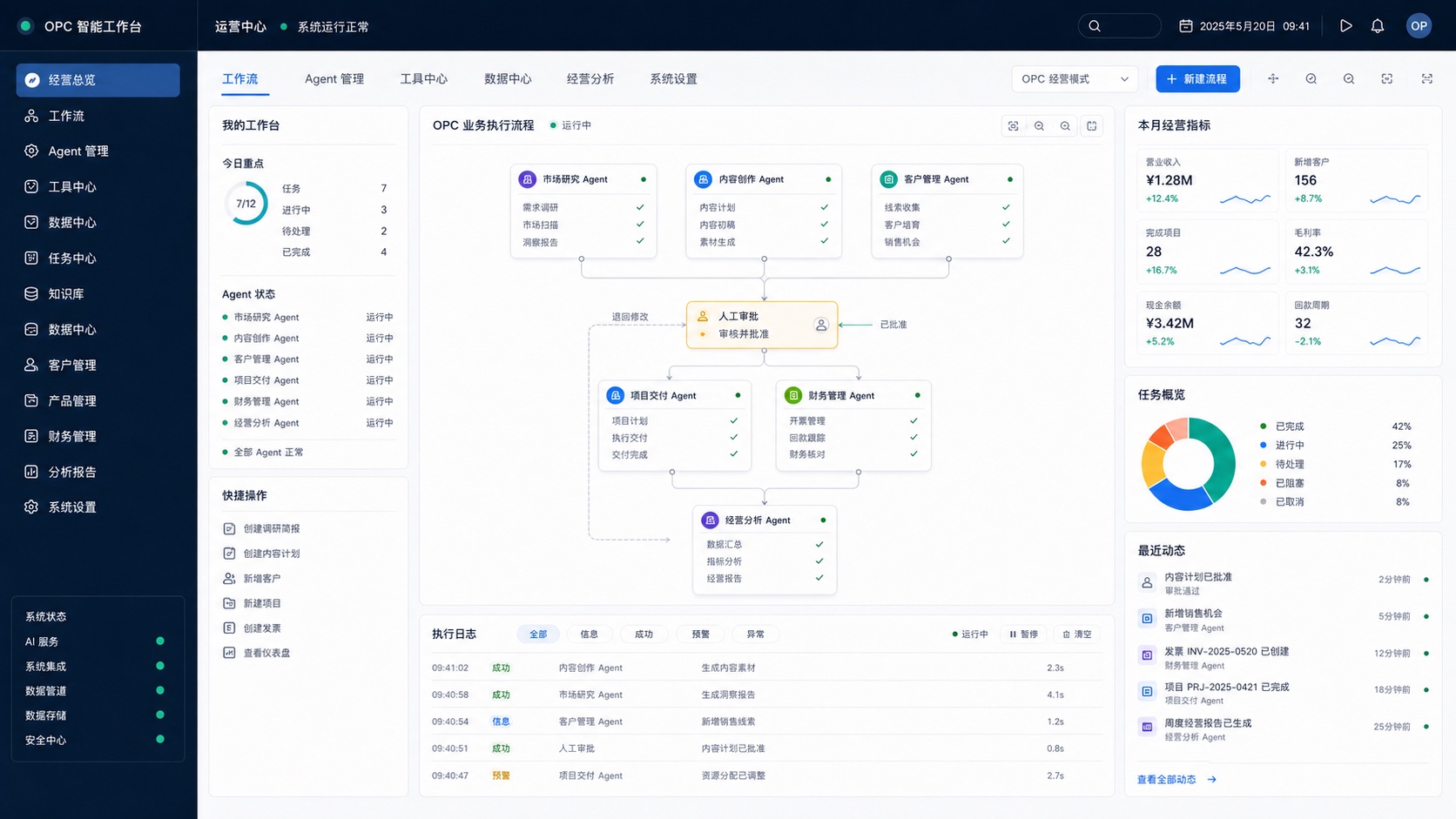
Multiple Agents should not be able to perform business directly after a free chat. A more secure approach is to use task status and workflow connections: the last step is to deliver structured results, the next step is to be dealt with according to rules, the key nodes are approved by themselves and the failed task is in manual queue.
Start with a process that can be validated within 30 days
The first OPC automation project would be useful to select processes with high frequency, clear input output, low risk and easy review of results, such as tabulation, pre-client information preparation, content archiving or project weekly production.
Record the time and quality of manual processing, and complete the prototype, real test run and redisclose. Additional tools or Agent will only be expanded once the first process is stable and yieldes quantifiable benefits.
- Week 1: Operational mandate and time audit
- Week 2: Knowledge, templates and field standardization
- Week 3: A workflow with an Agent prototype
- Week 4: Real operation, manual revision and input output re-display
OPC technical support should be delivered to maintainable capacity
Common results include business process maps, tool selection lists, knowledge structures, Agent descriptions, automated processes, competency matrices, cost statistics, operating manuals and training records.
Continuous observation on-line saves time, artificially modifys ratios, thread transformation, delivery quality, and tool costs. Unstable value-creating complex processes should be simplified or discontinued, avoiding the personal operating system becoming a new maintenance burden.
Convert OPC technical support from reading findings to project input
The most likely problem after reading methodological articles is the acceptance of principles, which are not translated into the next step. It is proposed that the head of operations organize a 60-90-minute mini-workshop, choosing only one real process and not rushing to discuss the full platform.
Step 1: Establishment of a current status and sample baseline
The data can be recorded for one to two weeks in a row, but with a reference to the sample cycle and operational fluctuations. Do not set a good rate of savings before pushing the data.
Step 2: Clarifying the initial closure and inaction
The first phase is designed to allow a chain to run and be retried, rather than to stack all OPC One Company, One Company AI, One Company Au utilisation and Agent into the same version.
Step 3: Match technical results to engineering evidence
It is important to maintain manual confirmation and execution logs when it comes to publishing, quotations, payments, customer commitments, and data deletions. The supplier's demonstration should use a sample confirmed by both parties. Production data that are not publicly available can be unsensitized but cannot be replaced by idealized testing data.
Step 4: Receiving, inspection and disking with the same calibre
Assuming that the original process handles 600 tasks per month, an average of 20 minutes and a return rate of 10 per cent, the target can be described as “six weeks after the start-up, with an average of 25 per cent less time than the original baseline, given the close complexity of the task.” This set of figures only demonstrates the measurement method and does not represent any client's results; the official indicators must be confirmed by the enterprise on the basis of its own sample.
- Operational material: flowchart, role, sample mission, current issues and baseline data
- Technical material: system inventory, interface, data access, deployment environment and security requirements
- Project material: first-phase scope, exclusions, liability matrix, milestones and change mechanisms
- Receiving and inspection material: test set, execution records, list of deficiencies, indicator queries and handover documents
When these materials are identified jointly by both the operational and technical parties, the method in the article is actually entered into the project. If key data, interface authorization or the responsible person are not in place, the logical next step is usually a limited diagnostic or PoC, rather than an immediate commitment to complete the work period and fixed total price.
Implement methodology to project action
- OPC technical support first solves business process problems and then configures the AI tool
- Knowledge, templates and mission standards are prerequisites for Agent ' s stabilization
- High-risk business operations must retain operator approval and liability
- Start with a quantifiable process, and decide whether to continue with the extension using the results
Relevant services, programmes and decision-making guidelines
OPC One-person A.I. Technical support
Understanding business diagnostics, tool selection, Agent, automated integration and ongoing support range
See detailsSolutionsOpC AI Agent Workstation
Organizing markets, customers, content, delivery and business data into controlled desks
See detailsThematic portalOne-person company of the OPC with AI Agent
Continue reading one-person business design, tools and multiAgent business methods
See detailsContinuing to reconcile common issues in project decision-making
What is the normal content of technical support by an OPC company?
The first phase should be built around a true closed circle in the recipient, sale, delivery or operation, rather than a large build-up of AI tools. The tool is to be consistent with the individual's time, budget and maintenance capabilities. The ultimate goal is to reduce duplication of effort while retaining manual control over client commitment and key decision-making.
View full answerOne-man company and OPC technical supportCan AI Agent follow up on clients, quotations and dispatch contracts automatically?
AI Agent can organize leads, alert follow-up, generate drafts of quotations, fill out contract variables and prepare for delivery without recommending a price, scope or legal provision for external commitments without artificial confirmation.
View full answerOne-man company and OPC technical supportHow should data be integrated when dispersed using multiple AI tools?
First, identify the primary data system of clients, projects, contracts and knowledge, then position other AI tools as callers or processors, rather than keep a single primary record for each tool. Prioritize the use of official API, Webbook or regular export of synchronized fields, and harmonize customer and project identification. For unexportable closed tools, the risk of migration should be assessed and the critical business assets avoided.
View full answerOne-man company and OPC technical supportWhat technology tools should be deployed first when a single company is starting to operate?
A company does not need to purchase complete enterprise software from the outset, but first establishes six basic types of customer trails, project assignments, documentation knowledge, contract collection, account security, and data backup. Each type prioritizes a primary tool that runs the shortest process from the time of the receipt to the time of delivery, and adds automation and AIAgent based on duplication of effort. The more efficient the tool, the more important is whether it can produce a unified record and stabilize the process.
View full answerNeed to build up an OPC capability for yourself?
We provide OPC capability diagnostics, AI tool selection, professional Agent, automated integration, deployment training and ongoing technical support.