The OPC technical support first addressed business bottlenecks, not tool anxiety
The difficulty that is common to a single company is not the total absence of tools, but the spread of customer information, content material, project progress, delivery templates and operating data in chats, documents, tables and multiple subscriptions.
The OPC technical support should therefore identify time bottlenecks: which tasks are duplicated weekly, which waits for impact to be met, which deliveries are easy to return to work, and which information is often not available. Only if current frequency, time-consuming and erroneous consequences are shown are it appropriate to judge whether templates, generic automation, AI workflow or customAgent should be used.
Service scope I: diagnosis of business processes and tool chains
The diagnosis starts with a complete closed loop, such as a search for content, a request for a lead, a request for a bid, or a project to start up and deliver a duplicate.
The tool selection does not simply give a list of popular software, but rather compares Chinese support, data export, API, privileges, stability, costs and learning costs. Problems that can be configured with existing tools need not be customised; they are only considered for development if cross-tool connections, business rules or exclusive experience form long-term value.
- Development of the OPC Business Closed Ring Chart and Time Use Baseline
- Inventory of accounts, data, subscriptions and exportability
- Clearly set priorities for retention, replacement, connectivity and customization development
Service range II: individual knowledge base, template and business data base
To stabilize its work, Agent must read the consolidated brand calibre, product information, service boundaries, quotation rules, delivery templates and historical experience. knowledge case construction includes catalogues, sources, versions, labels, privileges and responsibilities for updating, not uploading all documents once.
The first period can be light, but fields and synchronised directions must be harmonized.
Service range III: Agent, AI workflow and system connection
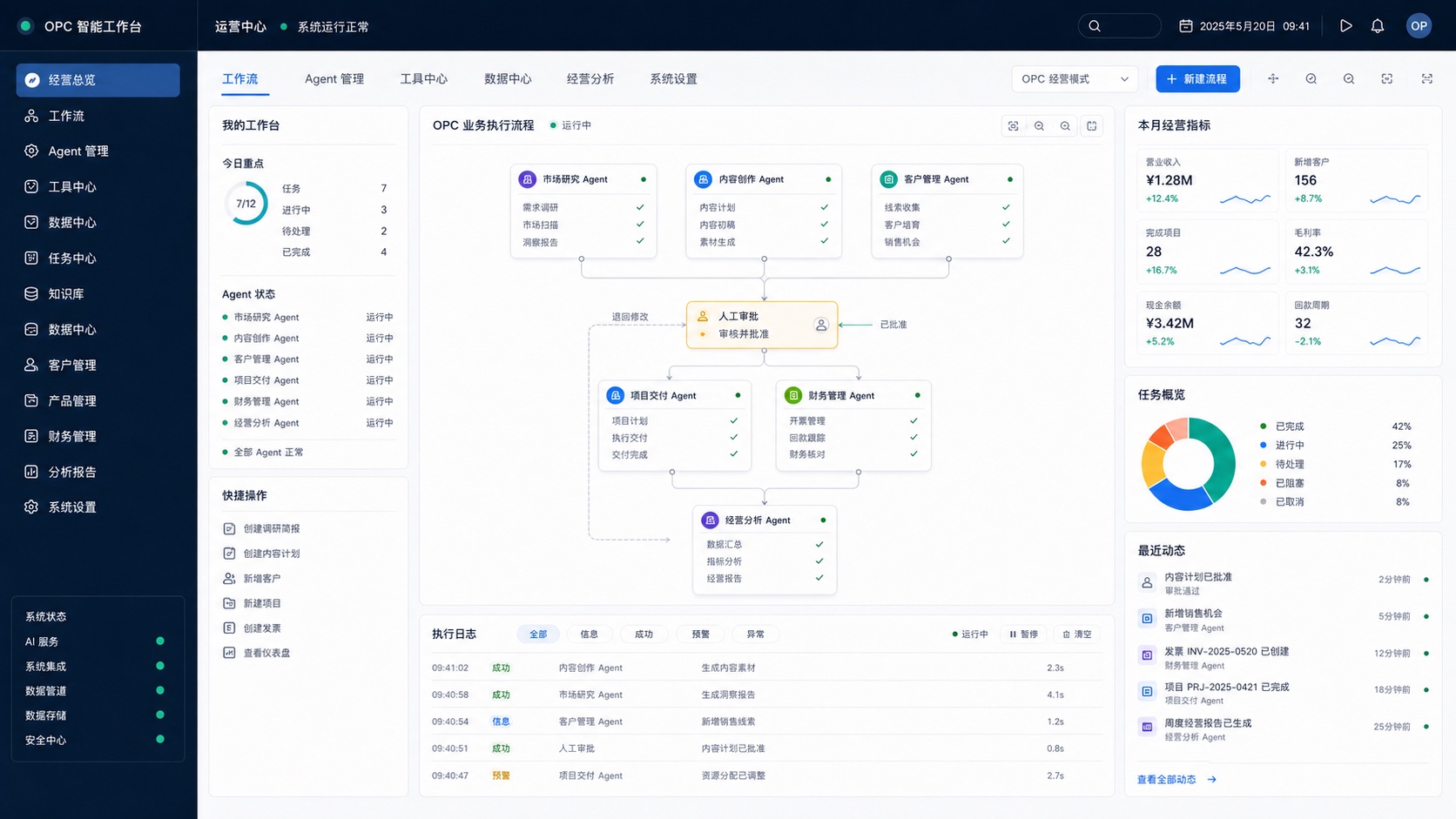
The usual Agent roles include market research, content aids, lead-up, customer follow-up alerts, first drafts of programs, delivery checks and weekly reports.
The web-based forms, postboxes, documents, calendars, CRM, project management and information tools can be connected through API or automated platform. The process design addresses the repetition of triggers, interface failure, model output anomalies and account-performation changes, and provides manual queues for important tasks, without automated silence being allowed to lose client information.
- Public publication, quotations, payments and customer commitment to retain manual confirmation
- Tool account held by operator and minimal permissions set
- Recording of execution logs, causes of failure and modeling tool costs
How to estimate costs and implement the OPC technical support
The first proposal consists of selecting only one high frequency closed loop, giving priority to mature tools and low code connections to validate values; and the process is stable and calls are determined before a decision is made on the development of an exclusive workstation or Agent.
A reasonable rhythm can be divided into two weeks of diagnosis and blueprint, two to four weeks of prototype and connection, four to eight weeks of real-life observation. The cycle is only an example, influenced by the speed of documentation, interface opening and operator feedback.
How to accept and accept OPC technical support projects
The operator must be able to independently modify the usual templates, view the operational status, suspend the automation and export core data, and avoid relying on the operator to maintain the system.
Example: An OPC takes 10 hours per week to organize the clues and the weekly project report, and the first target can be an automatic completion of the information aggregation and first draft, reducing the manual time to six hours, while the critical field completeness rate is not less than the original process, and all external content is manually confirmed. This is only an example of measurement, and the formal target needs to be identified in conjunction with the business baseline.
- Delivery of business process maps, account lists, Agent and workflow configuration
- Availability of knowledge catalogues, templates, operational manuals and trouble management instructions
- To save time, quality, manual intervention and cost to sustain the re-entry
Moving from reading findings to project input for OPC technical support
The most likely problem after reading methodological articles is the acceptance of principles, which are not translated into the next step. It is proposed that the head of operations organize a 60-90-minute mini-workshop, choosing only one real process and not rushing to discuss the full platform.
Step 1: Establishment of a current status and sample baseline
The most recent normal, unusual and border tasks are extracted around OPC technical support to address business bottlenecks, not tool anxiety, and records monthly processing, waiting times, actual processing time, back-to-work rates, manual contact points, error consequences and current tools. If data are insufficient, they can be recorded for one to two weeks, but with a reference to sample cycles and business fluctuations.
Step 2: Clarifying the initial closure and inaction
The first phase is designed to allow a chain to run continuously and be registrable, rather than to add to the same version the costs of OPC technical support, OPC service acceptance, and one-person company tool costs.
Step 3: Match technical results to engineering evidence
A tracking relationship between demand numbers, sample numbers, test results and versions is built around Service Scope II: Personal knowledge base, templates and business data. OPC has limited resources and should record the actual time saved by the operator, manual review rates, tool subscriptions and model call costs. When publishing, quotations, payments, client commitments and data deletions, manual confirmation and execution logs must be maintained. Vendor demonstrations should use a sample confirmed by both parties; undissensitized production data are not available, but idealized testing data cannot be used in place of real conditions.
Step 4: Receiving, inspection and disking with the same calibre
Assuming that the original process handles 600 tasks per month, an average of 20 minutes and a return rate of 10 per cent, the target can be described as “six weeks after the start-up, with an average of 25 per cent less time than the original baseline, given the close complexity of the task.” The set only demonstrates the measurement method and does not represent any client's results; the official indicators must be identified by the enterprise on the basis of its own sample.
- Operational material: flowchart, role, sample mission, current issues and baseline data
- Technical material: system inventory, interface, data access, deployment environment and security requirements
- Project material: first-phase scope, exclusions, liability matrix, milestones and change mechanisms
- Receiving and inspection material: test set, execution records, list of deficiencies, indicator queries and handover documents
When these materials are identified jointly by both the operational and technical parties, the method in the article is actually entered into the project. If key data, interface authorization or the responsible person are not in place, the logical next step is usually a limited diagnostic or PoC, rather than an immediate commitment to complete the work period and fixed total price.
Implement methodology to project action
- OPC technical support starts with closed loops and time bottlenecks, not with the number of tools
- Knowledge, data, authority and manual clearance to determine whether Agent is controlled
- First, check a closed ring, then expand the proprietary capacity based on the actual benefits.
Relevant services, programmes and decision-making guidelines
OPC One-person Technical Support
View diagnostics, tools, Agent, integration and ongoing support range
See detailsSolutionsOpC AI Agent Workstation
Understanding a person ' s managed working desk structure and acceptance methods
See detailsCapability sceneOPC AI Operating Desk, Professional Service
View client, knowledge, project and Agent ' s C-level competency scenario
See detailsContinuing to reconcile common issues in project decision-making
What is the normal content of technical support by an OPC company?
The first phase should be built around a true closed circle in the recipient, sale, delivery or operation, rather than a large build-up of AI tools. The tool is to be consistent with the individual's time, budget and maintenance capabilities. The ultimate goal is to reduce duplication of effort while retaining manual control over client commitment and key decision-making.
View full answerOne-man company and OPC technical supportCan AI Agent follow up on clients, quotations and dispatch contracts automatically?
AI Agent can organize leads, alert follow-up, generate drafts of quotations, fill out contract variables and prepare for delivery without recommending a price, scope or legal provision for external commitments without artificial confirmation.
View full answerOne-man company and OPC technical supportHow should data be integrated when dispersed using multiple AI tools?
First, identify the primary data system of clients, projects, contracts and knowledge, then position other AI tools as callers or processors, rather than keep a single primary record for each tool. Prioritize the use of official API, Webbook or regular export of synchronized fields, and harmonize customer and project identification. For unexportable closed tools, the risk of migration should be assessed and the critical business assets avoided.
View full answerOne-man company and OPC technical supportWhat technology tools should be deployed first when a single company is starting to operate?
A company does not need to purchase complete enterprise software from the outset, but first establishes six basic types of customer trails, project assignments, documentation knowledge, contract collection, account security, and data backup. Each type prioritizes a primary tool that runs the shortest process from the time of the receipt to the time of delivery, and adds automation and AIAgent based on duplication of effort. The more efficient the tool, the more important is whether it can produce a unified record and stabilize the process.
View full answerNeed to build up an OPC capability for yourself?
We provide OPC capability diagnostics, AI tool selection, professional Agent, automated integration, deployment training and ongoing technical support.