
Business closed circle diagnosis
To determine which steps AI is specifically involved in.Recover users, inputs, business objects, existing systems, manual rules, outputs, follow-up actions and current processing baselines.
What is needed is not just an AI answer, but a system that handles operations? This service plans account lines, business clients, status processes and AI support capabilities together, and applies to offers, work orders, project delivery, member operations, content clearances, and SaaS desks. First, it is clear who uses the system, what is recorded, and what actions must be manually identified.
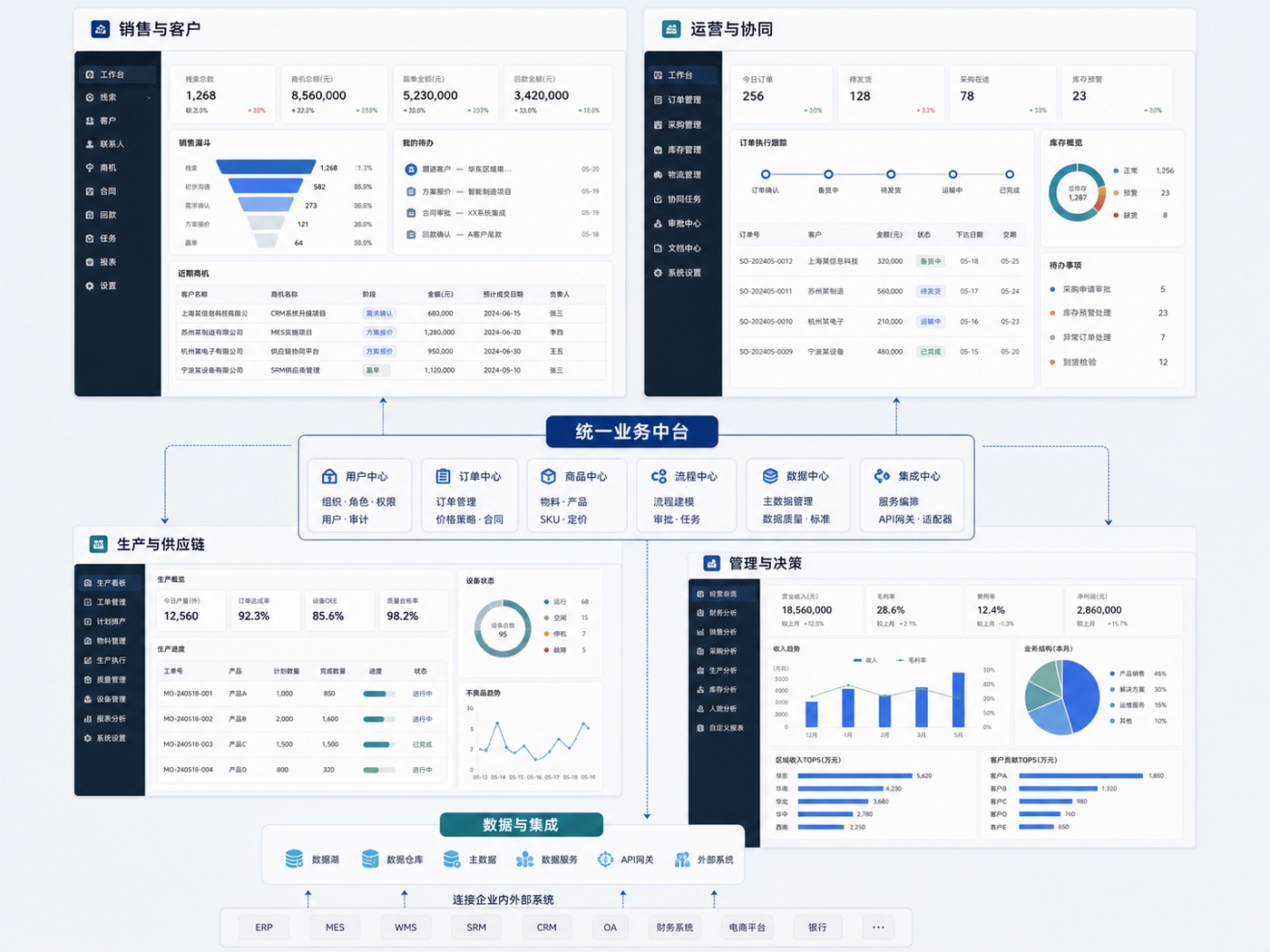
AI Operations Systems build requires the simultaneous design of business data, roles, process state and interfaces; access to old systems increases enabling capacity without changing the original primary responsibility. If the existing system is capable of carrying operations, it is not necessary to rebuild the entire system because of the addition of AI. The two can be phased in, but it should be determined which system has the final business record.
The implementation boundaries and acceptances for this category of projects are described below.Look directly at the details.
The AOS custom development is appropriate for AI to understand the business-specific information, integrate the current business state, and generate results under delegated authority or assist in the execution of actions. It is recommended that a quantitative closed loop be selected, identifying the main system, the target of the operation, the artificial baseline and the consequences of the error, and then validate the model, knowledge, rules and interface with the real task PoC.
The level of uncertainty is reduced by stages before deciding on the scale of inputs and the modalities of cooperation.
Recover users, inputs, business objects, existing systems, manual rules, outputs, follow-up actions and current processing baselines.
Using normal, unusual, missing and high-risk sample comparison models, RAG, rules, workflow and manual clearance routes.
Products, identity clearances, business interfaces, audits, retreats, testing, deployment, monitoring and continuous evaluation completed.
AI should not replace certainty control over amounts, contracts, compliance, security and formal business. Clients are responsible for business rules, data authorizations and high-risk outcome confirmation; model API, computing power, commercial software licences and third-party interface costs are presented as actual programmes.
The name of the system does not determine the programme, but what context AI reads, what task it performs, whether it changes the official business status and who reviews and recovers when an error occurs.
The selection of the scenes from the user ' s mission, official data and business responsibilities is not based on the software abbreviation for mechanical solutions.
Threading, client research, communication summaries, follow-up recommendations, draft programmes and CRM are controlled back to allow AI to work around the client life cycle.
Knowledge aids, conversational quality checks, intent identification, worksheet assignments, accessories advice and service reloads, linking passenger service, worksheets and on-site service systems.
Request for quotation understanding, smart quotations, order clearance, abnormal recognition, performance alerts and payment reconciliations, service electricians, platforms, doors and subscriptions.
Summary of requirements, contract review, obligation tracking, risk alerts, summary of progress and resource proposals, linking project delivery to contract management.
Instrument recognition, cost audit, reconciliation support, monthly check, cash flow alerts and business analysis of natural languages, maintaining financial rules and approval responsibilities.
Requirement alignment, request for quotations, vendor price comparison, comparison of terms and performance risk tips, linking procurement, contract and payment status.
Proceedings, institutional queries, approval materials, task dismantling, training assistants and internal help desks to reduce duplication of cross-sectoral information.
Multiform information resolution, access, Question and Answer, content generation, version checking and document review to create a retrospective flow of knowledge.
Indicators are asked questions and answers, taken-down analyses, abnormal diagnosis, predictive support and report generation, with all results bound to the calibration of indicators, data time and access rights.
Clarification of requirements, code aids, test generation, classification of deficiencies, release checks and technical documentation maintenance to allow AI to enter the software delivery chain.
Selection, documentation, content generation, compliance review, labelling recommendations and user feedback analysis to form an approved, redisclosed back-office.
Building of AI search, Copilot, Agent, Smart Creative or Industrial Workstations for clients, and filling in multi-tenant, line, billing and operating capabilities.
AI can only become a deliverable and capable of taking over productive capacity if it has access to access rights, interfaces, rules, assessments and operating systems.
Connect current customers, orders, projects, contracts or worksheets rather than providing an isolated reminder to the model.
(c) To inherit user, organization, tenant, field and business object privileges and to authorize a hierarchy of queries, suggestions, writing and irreversible actions.
Operational capability to identify parameters for verification, thioperate, limit flow, retest and version of contracts through API, MCP, messaging or workflow.
Amounts, contracts, issuance, deletions and official status changes are closed by the rules of certainty and high-risk outcomes are subject to manual review.
Fixed set of real tasks, tracking answers, references, tools call, manual modifications, business results, delays and single effective mission costs.
Transfer of source code, configuration, tips, knowledge, assessment, deployment and transport data and continuous management of model, data and operational rule changes.
The first issue does not recommend simultaneous coverage of 12 types of systems. A more conservative approach is to select a business closed loop with a process mass that is statistically available, data available, errors that can be manually plowed, and then re-referenced to other systems with a real sample.
AI is stuck on a copy paste and operators still have to move information between multiple systems
The model does not understand the owner data, rules and current business status and the output cannot be used directly
Build robotics and workflows in different sectors, with decentralized data, authority and maintenance responsibilities
The demonstration was good, but the abnormality, the consequences of the error and the manual takeover were not designed.
Project delivery only pages or model accounts, lack of source code, interface, evaluation and operating assets
AI Operations System Needs Diagnosis, Process Recovery and Initial Closed-ring Planning
Industry AI application, Enterprise Management System AI module and proprietary desk development
RAG knowledge, structured data, business rules and real mission assessments
AI Agent, AI workflow, tool call and manual approval organization
ERP, CRM, OA, MES, WMS, FIS software interface integration
Model gateway, multimodel route, structured output and abnormally downgraded
Identity privileges, field-level data control, log auditing and sensitive information protection
Product front, backstage configuration, surveillance alarms and greyscale release
Knowledge update, model assessment, cost and adoption rate operation after online
The service boundaries, budget bases and modalities of implementation for different phases of the project are not identical and can be further assessed in conjunction with the following.
The final delivery boundaries are defined according to the scope of services, the construction phase and the modalities of cooperation, and are described below as common results.
Service coverage and business closure required for the first phase: AOS needs diagnosis, process recovery and initial closed loop planning, industry AI application, Enterprise Management System AIS module and exclusive desktop development
Level of integrity of existing codes, data, systems, equipment and documents, and scope of coverage to be audited, relocated or re-engineered
Number of third-party interfaces, coordination responsibilities, data quality, unusual compensation and external supplier cooperation
Non-functional requirements such as performance, availability, security, authority, audit, compliance and access windows
Delivery depth and long-term responsibilities: interface compacts, competency matrix, audit and abnormal regression mechanisms, test assessment, deployment roll-back, operational transport of peacekeeping knowledge transfer information, and quality assurance, peacekeeping continuity range
Project objectives, responsible persons and acceptance criteria are not established
Key accounts, data, interfaces or business authorizations not available
Only the maximum price or very short cycle is sought, and the necessary tests and quality control are not accepted
The common needs of Internet and service enterprises also include multi-tenant SaaS, customer success, subscription billing, project contracts, worksheet services, membership interests, training examinations, content management, channel operations and knowledge services.
The AIS judgement does not directly cover service levels or close complaints. The system must record the person, version, customer confirmation and reason for reopening, preventing the production of content from being disconnected from actual performance.
Clients, orders, service contracts and knowledge information may come from different platforms. For each field, the main system, the time of update, conflict management and removal strategy are defined; multi-tenant scenarios are also isolated from search, cache and task queue. Batch synchronization, event consumption and manual backup should track the source, otherwise AI may describe the old data as the latest reality and spread errors to multiple systems.
In addition to normal filing, review, and closure, the withdrawal, duplicate submission, and amendment, account number discontinuation and cross-tenant access are tested.
The following is a recommended assessment of the performance of the customer, not of the customer, nor of the uniform commitment to meet the standard.
| Checkpoint | How do you check it? | Avoid miscalculation. |
|---|---|---|
| Closed-ring integrity | From creation to closure and restarting to state chart execution | Keep the operator and the basis for each status migration |
| Data consistency | Check the main system and workstation by business unique number | There's only one business result after repeating information and compensating. |
| Permission quarantine. | Test roles, organization and tenant boundaries | Query, search, cache and export are controlled simultaneously |
De-sensitization real cases: chaining POS: Reference can be made to transactions, door shop and interface synergetic experience; this case is not proof of the online effect of the AI operating system.
Whether the new system is integrated with the existing software
Each stage has clear objectives, participatory roles and assessable outcomes, and important decisions are not left to the end of the project.
The most common issues before cooperation are clearly stated in advance.
The AI Operations System places greater emphasis on business objects, process status, role privileges, system writing back and traceable results. Besides models and RAG, traditional software, interfaces, data, approval, monitoring and transport engineering are required.
Priority is given to tasks such as data review, proposal preparation, work orders assignment, customer follow-up and business analysis, which are stable, available for samples, available for inspection, and labour-intensive and faulty.
Not necessarily. Most projects should first validate mature models, RAGs, rules, tools and structured validation; fine-tuning is assessed only when there are stable behavioural gaps and there are sufficient quantities of high-quality samples.
The original system continues to be responsible for customers, orders, inventories, amounts and official status, and AI services provide understanding, generation, analysis or operational advice through controlled interfaces.
The key effects, data or interfaces are unknown before the product is developed using a genuine task record of quality, serious error, delay, cost and manual intervention.
The fixed task set effects, business closed loops, interface write-backs, competency audits, abnormal retreats, performance costs and asset deliveries should be checked and not be viewed only in several model presentations.
The AOS customization development includes business process diagnostics, real task and sample organization, model and RAG route validation, product front-end, enterprise system interface, identity clearance, manual clearance, evaluation testing, and deployment. It does not add a chat window to the software, but allows AAI to work within a defined business target and accountability boundary. The enterprise should select a quantifiable closed loop before deciding on the PoC and production range.
View full answerAI Operations System, PoC and Enterprise AIAccess to existing systems is usually maintained for existing products and user portals, with only additional search, generation, analysis or Agent capabilities; the development of the AI business system may re-engineer a complete process, a dedicated desk and a back office. Both should respect data responsibility for the main systems, such as ERP, CRM. The choice is based on whether the existing system can carry the target process, rather than on which name is more advanced.
View full answerAI Operations System, PoC and Enterprise AIThe sample should cover normal, missing, conflicting and high-risk situations. Data numbers are not the only criteria. Explanatory, legal authorization, updated responsibility and real work are more important.
View full answerAI Operations System, PoC and Enterprise AIAI PoC should deliver the mission range, real sample collections, baselines, prototypes or validation codes, evaluation results, types of failures, costs and production gaps; AI MVP should also deliver complete minimum closed loops, necessary privileges, data and feedback records that are available to the target user. Neither is equal to the production system. The deliverable must enable the enterprise to re-evaluate the findings and decide to continue, adjust or discontinue.
View full answerView the needs, data models, SQL recommendations, how collaboration with R & D can be closed
For more information.Implementation programmeView meeting recognition, task dismantling, liability confirmation, alarm and system writeback path
For more information.Implementation programmeViewing methods of synergetic curriculum vitae extraction, job matching, manual review and recruitment systems
For more information.Implementation programmeView knowledge import, subject generation, clearance, examination and competency analysis processes
For more information.Needs guideEstimable needs organized by mandate, data, systems, risk and acceptance indicators
For more information.Contract boundaryIdentify data, hints, model results, source code and account attribution before opening an item
For more information.